17 Best Applicant Tracking Systems for Small Businesses (2026)
The best ATS for small businesses, updated by our in-house HR tech experts and researchers for 2025.









A small business ATS is software designed for teams with limited HR resources to digitize and enhance their applicant tracking process. For such companies, there’s a fine line between bootstrapping your budget and shooting yourself in the foot, and our experience tells us that the ROI on the proper ATS software catering to SMB growth will make you wonder why you spent so long making do with Excel.
In this guide, our HR tech experts will introduce you to a few relatively affordable applicant tracking systems for small businesses that will pay off dividends if you’re looking to streamline your hiring process with automation, improve your recruitment efficiency, or better your employer brand and candidate experience.
We have assessed over 50 applicant tracking systems specifically through the lens of small business needs, combining hands-on product testing, live vendor demos, and expert and user feedback. Based on our research and experience, the best ATS platforms for small businesses tend to excel in resume parsing, job posting, pipeline management/user experience, and integration capacity.
- Resume Parsing: The ability to reliably parse resumes and provide meaningful analytics is a core feature of any ATS, but for small businesses, it’s especially critical due to their often modest human resources. A small business can’t afford a bad hire, but you also don’t want to spend countless precious hours going through hundreds of resumes. Hence, resume parsing should filter the best candidates, saving you time. To gauge each ATS’s resume parsing capability, we ran simulations where we sent sample resumes through the system’s application pipeline and assessed how well it extracted and organized key data.
- Job Posting: Whether a small business is expanding across borders or focusing on niche roles, tight budgets are a universal challenge. That’s why we prioritized ATS tools that maximize job posting efficiency by offering access to a good mix of job boards (both general and niche) and provide tools like job description crafting, salary estimators, and language support to help teams tailor postings effectively. To ensure job ads meet relevant legal requirements, we also verified that each platform complies with GDPR and EEOC standards and maintains a clear audit trail of job posting activity.
- Pipeline Management and User Experience: Pipeline management supports automation and efficiency, the foundation of candidate experience. A well-designed small business ATS is crucial because it reflects your company's image. We ran candidate simulations through each pipeline to test for intuitiveness, accessibility, and cohesive visual design. Then, we assessed the performance from both the candidate's and recruiter's perspectives.
- ATS Integration: Compatibility with other software is essential because even at small businesses, the candidate pipeline tends to and should weave through multiple internal data points and systems, such as calendars for scheduling, candidate sourcing tools, and background check services. To ensure each ATS would work with most HR ecosystems, our researchers checked for compatibility with dozens of the top HR tools used by small businesses.
You can read our HR tech assessment process for more details.



Workable

We found Workable an excellent ATS for small businesses because it combines ease of use, broad job posting reach, and scalable features that help lean teams run structured, professional hiring processes without needing extra tools or technical support.
PROS
- Allows SMBs to explore the platform’s offerings via a 15-day free trial.
- Supports one-click job posting to over 200 sites and lets you access its talent pool with over 400 million profiles.
- You can conduct cognitive and personality assessments within Wordable, without needing third-party tools.
- The anonymized screening feature can help reduce unconscious hiring bias.
- You can post jobs with one click to over 200 sites. You also get access to access to Workable’s talent pool with over 400 million profiles.
- Workable has built-in cognitive and personality candidate assessment. The platform also has features for offer management, which means you can create offer letters and collect e-signatures without needing to use third-party tools
- You can reduce unconscious hiring bias with Workable’s anonymized screening feature. It helps you hide identifying candidate information from the sourced and applied stages of the hiring process.
CONS
- No automated reference checking and onboarding features.
- Features like candidate texting, video interviews, and assessments are not included in plans but must be bought separately.
- Workable could do better with duplicate candidate merging since one person will have numerous candidate records on the ATS if they apply for multiple positions.
- The reporting feature needs to be more detailed and customizable.
- The candidate search function could have more filters.
- Workable doesn’t provide automated reference checking and onboarding features.
- Useful features such as candidate texting, video interviews, and assessments are not offered in any of Workable’’s plans and instead, sold separately.
- Several users complained about the reporting feature not being detailed or customizable enough, and that the candidate search function could use more filters.
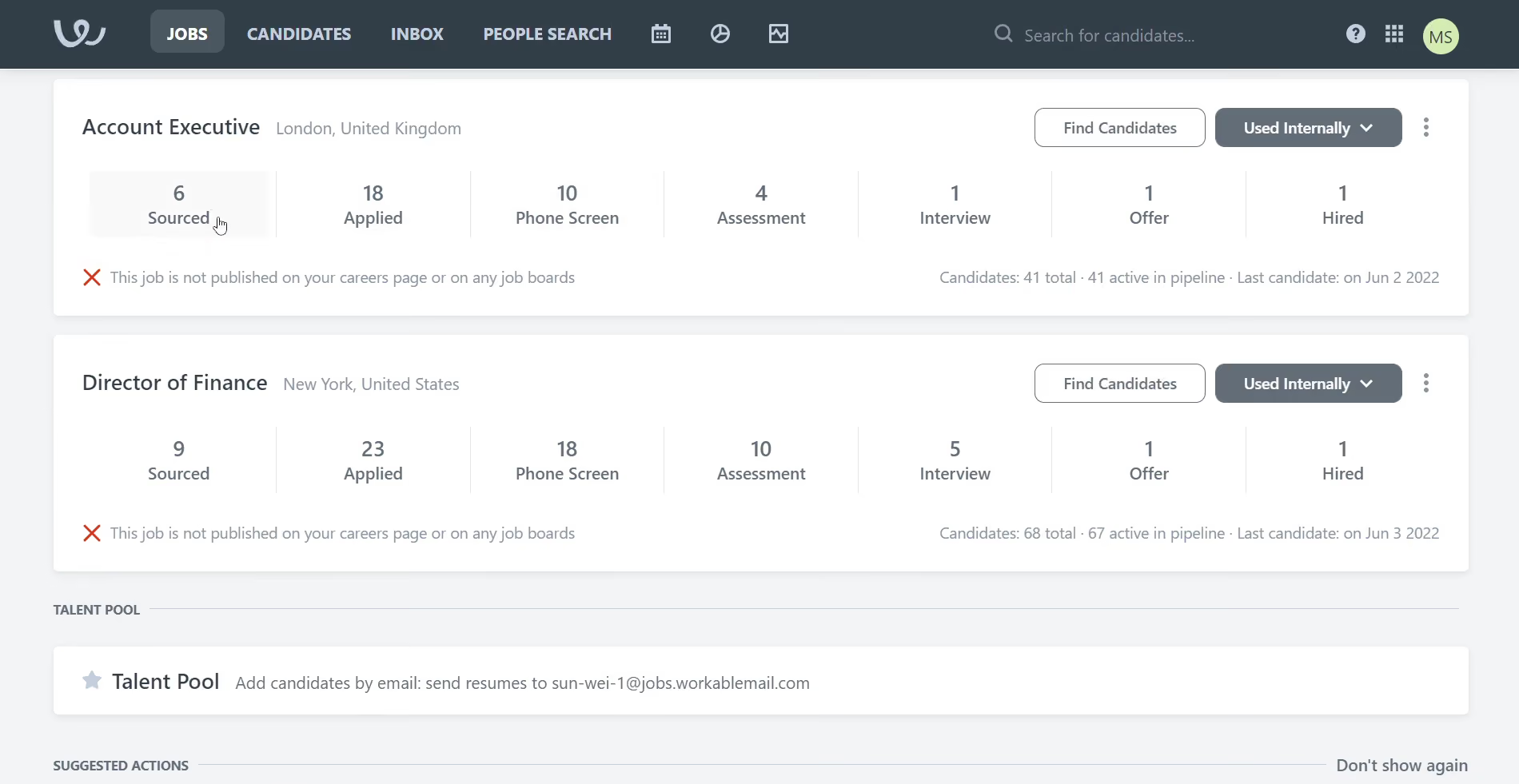
Through our testing, demos, and user feedback, we found that Workable ATS provides small businesses with an ideal blend of ease, flexibility, and a future-ready design. While many ATS platforms either oversimplify for small teams or overwhelm them with enterprise-level complexity, Workable strikes a rare balance: it’s intuitive enough for small hiring teams to adopt quickly, yet robust enough to scale as the business grows.
First, let’s mention this ATS’s plug-and-play setup: small businesses often don’t have the IT resources to configure complex systems, and Workable’s straightforward onboarding, 15-day free trial, and clean interface make it easy to get started. The platform also provides broad job posting reach, giving lean teams access to over 200 job boards and 400 million candidate profiles, which helps maximize recruiting impact without adding extra headcount or budget.
Importantly, Workable includes built-in tools that small businesses often lack, such as anonymized screening, cognitive and personality assessments, and structured interview kits. These are the features that can help your small business run a fair, efficient, and consistent hiring process without relying on additional tools or external vendors.
We also appreciate that Workable’s pricing is transparent and its platform is scalable, meaning small teams can adopt the system with confidence that it won’t become obsolete as they expand. However, be mindful that some features, like video interviewing and texting, actually cost extra as they are paid add-ons. Additionally, while the platform offers reporting tools, as highlighted in the user review from Angela Lowry right below, these are quite basic and often require teams to export data into spreadsheets for meaningful analysis.
Workable has been used by over 20,000 organizations, including Sephora, Forbes, Bevi, Moodle, and Navarro.
Workable provides different pricing options to accommodate various business needs. However, their Starter plan was removed in mid 2025. That leaves only the Standard and Premier plans, which cost $299 and $599 per month respectively. For organizations looking for integrated solutions, bundled options that include HR and recruiting functionalities start at $349 per month.

Best For
Workable’s ATS is a good bet for small businesses aiming to scale, as you can start small and know the platform has the capacity to handle more complex needs as you grow.


We leverage Workable's platform to broadcast job opportunities across a wide range of prominent channels, such as Indeed, LinkedIn, Facebook, Google, and Glassdoor, ensuring maximum visibility for our job postings.
Upon receiving applications, Workable enables me to assign specific roles to the relevant hiring manager within our organization, streamlining the recruitment process.
Each hiring manager uses Workable's intuitive interface to assess candidate profiles, review CVs, and track application progress from a centralized dashboard.
This collaborative approach fosters transparency and accountability, engaging all stakeholders in the hiring process.
Workable acts as a comprehensive solution, providing a centralized hub for optimizing recruitment and onboarding processes. It consolidates various functionalities necessary for efficient talent acquisition and the seamless integration of new hires.
From posting job openings to managing applications and scheduling interviews, Workable streamlines every step of the recruitment lifecycle. A standout feature is its ability to foster collaboration between HR teams and hiring managers, ensuring strategic and cohesive hiring decisions.
We were in search of a comprehensive solution to enhance our recruitment and streamline our onboarding processes. Workable emerged as the ideal platform to effectively meet these needs. It offers a suite of powerful recruitment tools, including job posting management, candidate sourcing, and applicant tracking. These features enable us to attract top talent, manage applications efficiently, and streamline the entire hiring process.
Workable allows us to tailor our recruitment workflows to our specific needs and organizational structure, enhancing efficiency and consistency across all hiring activities. It also facilitates collaboration among hiring teams with features like candidate feedback, interview scheduling, and communication tools, ensuring informed hiring decisions.
While Workable's interface is user-friendly, it can become overly complex or cluttered, particularly when navigating through multiple features or conducting advanced searches. A more streamlined and intuitive interface would improve usability.
Workable excels in providing an intuitive and user-friendly interface, making it accessible to users of all technical proficiencies. Its well-designed layout and straightforward navigation enhance usability, enabling users to efficiently perform recruitment tasks without the complications of complex interfaces.
When considering an ATS tool, evaluate its features and functionality. Ensure it includes essential capabilities such as job posting management, applicant tracking, CV review, candidate communication, interview scheduling, and reporting/analytics. Also, consider whether it offers advanced features like AI-driven candidate matching, automated workflows, and customizable dashboards to streamline the recruitment process.
Workable continually enhances its feature set, providing users with more robust tools for recruitment and hiring. Improvements to applicant tracking, job posting management, candidate communication, interview scheduling, and reporting/analytics have been made. New features such as AI-driven candidate matching, automated workflows, and customizable dashboards have been introduced to further streamline the recruitment process.
Workable is an excellent solution for businesses of all sizes, from small startups to large enterprises. Its versatility and scalability make it suitable for organizations at different stages of growth.
Workable may not be the best fit for very large enterprises with complex organizational structures and extensive hiring requirements, which may need more advanced features and customization options. Additionally, highly regulated industries such as healthcare, finance, or government may require specialized ATS solutions tailored to their specific regulations and security standards.

Recooty
Recooty offers a free-forever plan that allows users to post jobs on multiple platforms. The platform’s paid plans pack a handful of recruitment essentials at conservative prices, making it a great ATS option for SMBs.
PROS
- Features a user-friendly and simple interface for easy navigation.
- Offers competitive pricing, ensuring accessibility for small businesses.
- Users can test the software before subscribing through a free trial.
- Provides full set of ATS basics, including job posting, candidate tracking, interview scheduling, candidate assessment, offer management, and onboarding.
- Enables efficient job posting to multiple platforms with a "one-click" solution.
- Supports eight languages: German, English, French, Hindi, Italian, Spanish, Dutch, and Vietnamese.
- One user liked the usability of the software, stating that it is 'easy and self-explanatory.'
- The ability to post a job on multiple platforms makes it efficient, as per one user who labels Recooty a 'one-click job posting solution.'
- The company offers a cheap subscription, making it affordable for small businesses.
CONS
- Lacks mobile applications.
- No Chrome extension for importing candidates (e.g., from LinkedIn).
- Limited integrations (Slack and LinkedIn only).
- Suitable for small and medium-sized businesses.
- Not ideal for large enterprises with extensive hiring needs across multiple locations.
- The company does not have a mobile application.
- Recruitment features can be quite basic compared to some competitors.
- Integrations are somewhat limited.
- Not suitable for large enterprises with more job postings and locations.
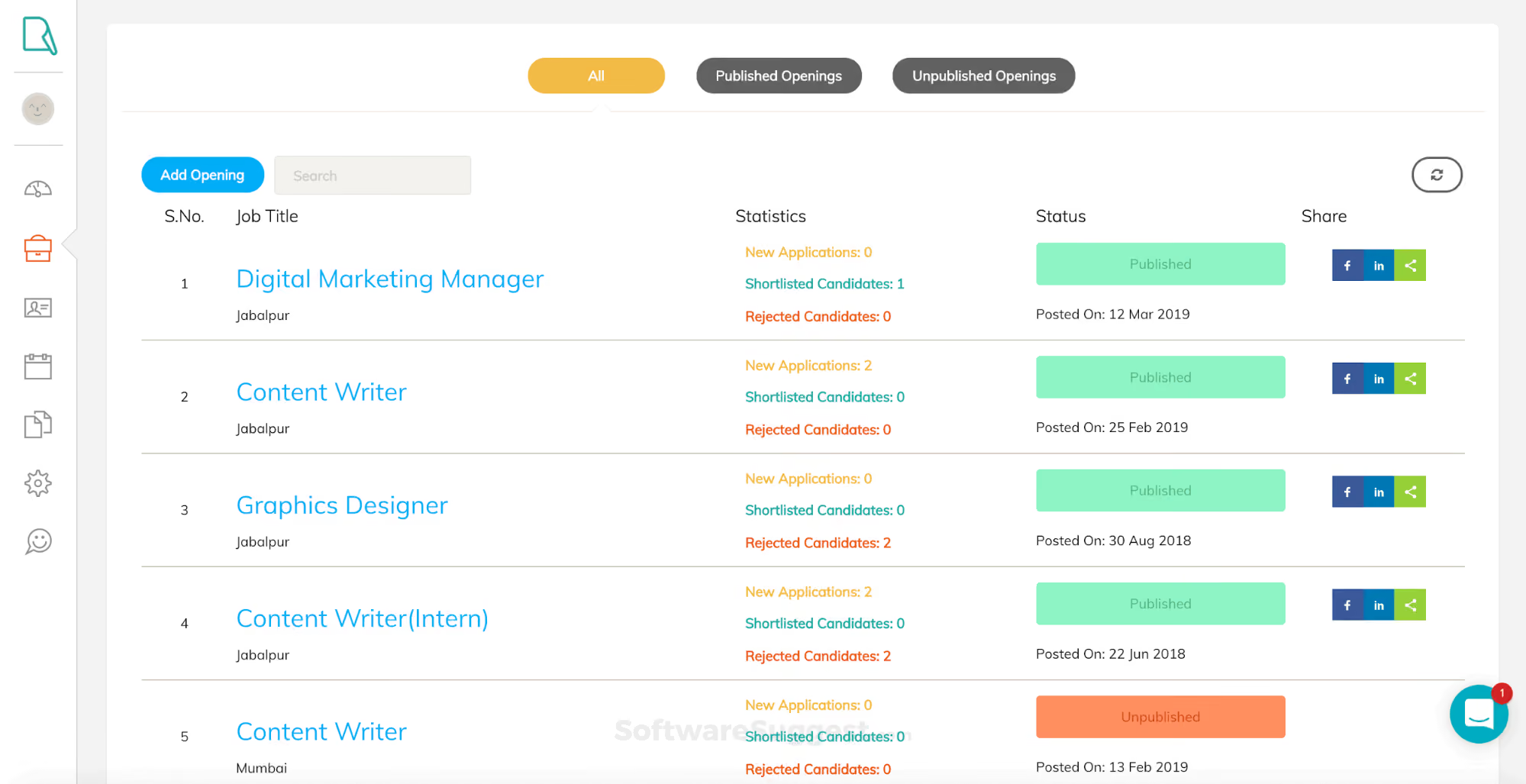
Recooty is great for SMBs looking for an easy-to-use, affordable, and efficient applicant tracking system. However, if you're looking for a more robust solution with more features, you may want to consider a different ATS.
Our in-house assessment showed that Recooty is a plug-and-play tool. It is easy to set up and easy to navigate. Users can post jobs to multiple boards, track applicants, and set up automated email notifications with just a few clicks. It’s not an exaggeration to say Recooty is a self-explanatory ATS.
Another thing we like about Recooty is its affordability. The software is priced competitively, and you can even start with the free plan. Though it’s limited to one active job at a time, it offers some good features like branded career pages, multiple job boards, and unlimited applications.
Recooty supports not only English but also seven additional languages. However, Recooty lacks a mobile app, despite pressure from users over the years. Recooty isn’t a good call for recruitment teams that need a Chrome extension to support their candidate search on websites like LinkedIn.
The level of customization is lacking compared to higher-priced ATSs in the space, and resume parsing is accessible for only the two highest-priced plans. Integration options also leave something to be desired, as you can only connect the ATS with your LinkedIn and Slack.
Sendlane, Airtable, Uber, Rack Bank, American Hospital, Trello.
Recooty offers a 15-day free trial. Their three paid subscription options start at $79 monthly (billed annually).
Best For
Recooty is an affordable ATS option ideal for small to mid-sized businesses needing minimal setup and multilingual hiring capabilities.
AvaHR
AvaHR has done a nice job with its customized hiring automation frameworks. We enjoyed the ability to post to 50+ job boards for free while showcasing our company culture with videos, photos, and text. Additionally, the Pipeline Triggers, which automate routine tasks based on the candidate's progress, are a standout feature that we've found to be quite rare among SMB-focused ATS solutions.
PROS
- Culture Profiles let you add videos, photos, and text to showcase your company's work environment.
- Pipeline Triggers automate repetitive actions based on a candidate's stage, such as sending thank-you emails or requesting hiring team feedback.
- Custom questionnaire builder for candidate pre-assessments.
- Data migration service is available at no additional cost.
- Transparent pricing, free trial available.
- Culture Profiles let you add videos, photos, and text to showcase your company's work environment.
- Pipeline Triggers automate repetitive actions based on a candidate's stage, such as sending thank-you emails or requesting hiring team feedback.
- Custom questionnaire builder for candidate pre-assessments.
- Data migration service is available at no additional cost.
- Transparent pricing, free trial available.
CONS
- No free plan, a free trial requires a credit card.
- Pricier than competitors like Loxo and Zoho Recruit.
- Additional charges for features like eSignatures and employee referrals.
- Interview scheduling feature is unavailable (still in development).
- No free plan, a free trial requires a credit card.
- Pricier than competitors like Loxo and Zoho Recruit.
- Additional charges for features like eSignatures and employee referrals.
- Interview scheduling feature is unavailable (still in development).
AvaHR stood out in our tests as a well-designed and functional ATS with solid automation and reporting features.
One apparent plus of this vendor is its transparent pricing and free trial offerings across its subscription plans. We signed up for the free trial of the Standard plan using a Gmail account. The only downside was having to provide credit card information to activate the trial, but other than that, the process was a breeze. Within minutes, we were all set to explore the tool.
Our first impression of AvaHR’s UI was that it was so well thought out. There was nearly nothing to be confused about. And it’s easy on the eye, too. Take the example of their AI job description creator. During our testing, it impressed us with the solid draft it produced with just a few sentences of role requirements provided. We also found it easy to get our application form ready. All we needed to do was define which fields were required and which were optional in the form settings.
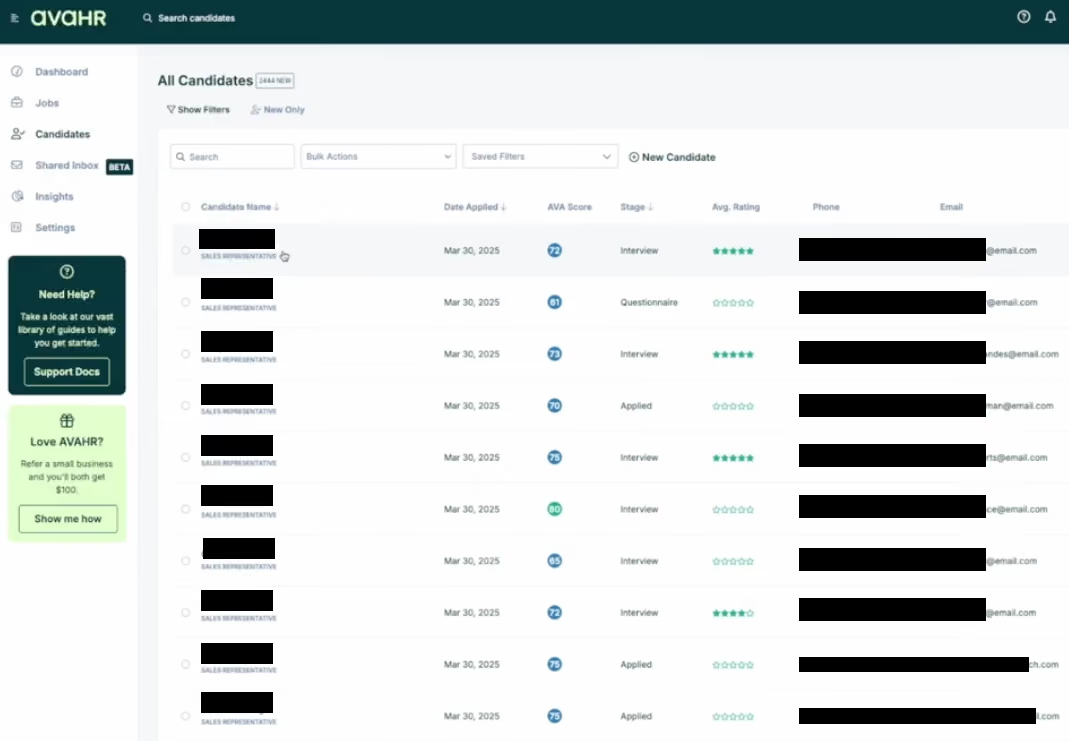
The Candidates section gave us a bird’s-eye view of all applicants, including their application dates, stages in the hiring process, and contact details. There was also a convenient Filters button in the top right corner that let us filter candidates based on their tag, stage, job title, department, and a few others. The system didn’t take more than a few seconds to provide results in our tests, but we couldn’t help but be disappointed to discover there was no Boolean or custom filter to be found.
AvaHR’s reporting met our expectations for an SMB-focused ATS. The tool has done a great job of providing key data, from total impressions to page views, clicks, and applications for each job posting. We particularly appreciated the clear visualizations offered by the overview bar and line chart. It made it easier to watch how our jobs were performing.

For businesses migrating from another ATS, you’re in luck! AvaHR’s team offers to handle data import at no extra fee.
However, we did notice that this ATS is slightly pricier than some competitors like Zoho Recruit. Additionally, features like eSignatures and employee referrals are not included in the lowest subscription plans and must be purchased separately if you want to use them.
1,000+ companies, including BuzzRX, Redirect Health, State Farm, and Margaritaville.
AvaHR offers three plans: Starter ($89/month), Grow ($179/month), and Pro ($279/month).
Best For
AvaHR is best suited for U.S.-based small to medium-sized businesses with 100 or more employees.

We rely heavily on the job posting features of AvaHR. We used to manually post an opening on 1-3 job board sites, but now we can create one job posting and AvaHR spreads that posting to almost 50 sites. I believe AvaHR can reach almost 100 sites if you wish.
Once candidates apply, the information comes to the AvaHR site so we don't need to check each individual job board. We can respond to the candidate directly from AvaHR and keep communication easy and streamlined. We can track the progress of our postings and see what stage each candidate is in the interviewing process.
- The job posting features are great and have saved us a tremendous amount of time.
- The centralized tracking of multiple job sites, multiple candidates, and multiple stages has made things easier for leadership to pop in and get an update on progress without bugging our HR Business Partners.
- The Culture Profile is also a nice touch. We're very proud of our company culture, and getting to show it off to potential future new hires is a great touch.
We have had AvaHR for almost 8 months now. We purchased AvaHR to help us centralize our hiring efforts as we recently welcomed in another HR Business Partner to help with posting positions all the way through to hire.
We knew we needed a system to reduce the administrative work we were putting into each and every job opening. We used to keep track of applicants via Google Spreadsheets, and we weren't doing more than 1-2 job posting sites at one time.
It was getting to be too much to manage for 1 person, and we needed our HR team to do more than just hiring efforts.
- I think the price is a bit steep, but all software is expensive. It's likely we save a lot in admin time, but it's hard to tell the exact ROI.
- Sometimes the site can be difficult when it comes to sorting out the disqualified candidates and our active ones.
- It would be nice if we could create some thresholds (i.e., must have a resume and cover letter) before candidates are allowed to submit an application.
AvaHR is just an ATS, not a full blown HRIS. This is nice because an HRIS is very expensive and extends beyond what we needed at the point our business is at. I feel like AvaHR is user friendly and modern compared to some other options. It's nice that AvaHR offers different pricing tiers depending on the size of our team and the features we use.
It's always a good idea to pause and think about who will handle the implementation of software within your company and how. It takes real time and focus to implement and adopt a solution like this.
The ease of use is also an important aspect to keep in mind. It's nice for leaders to be able to use AvaHR so they don't have to get updates from HR and can, instead, just log in to see how a job opening is doing.
AI tools like job description generators have been added, as well as job scoring and even candidate scoring options. They're only available on the Premium & Max plans though.
Small to mid-size businesses would be the best companies to think about adopting AvaHR.
Large enterprises would need more approval layers than what AvaHR offers. It also wouldn't be a good option for global companies who are hiring across different countries and languages.
.png)
Deel
Deel ATS stands out for how harmoniously it connects hiring with the rest of the employee lifecycle. Because it sits inside Deel’s broader HR and payroll platform, candidate data flows directly into onboarding, compensation, and payroll, reducing the need to move information between systems.
PROS
- Native connection to HR, payroll, and onboarding for end-to-end workflows.
- Built-in AI matching that highlights candidate fit based on job criteria.
- Strong interview workflow tools with scheduling, feedback, and recordings in one place.
- Embedded integrations with Google Workspace and Microsoft Teams.
- Centralized email communication with Gmail and Outlook integrations.
- Structured hiring stages and customizable workflows.
- Clear AI transparency with candidate disclosures and human oversight.
- Excellent 24/7 customer service with fast onboarding (2-3 days) and local payroll experts in each jurisdiction.
- Seamless integration with platforms like QuickBooks, BambooHR, and Greenhouse, plus custom integration options.
- User-friendly, self-service features enable quick setup; identity verification often takes under 24 hours.
- Automated invoices simplify payments, provided they're in English.
CONS
- Limited job board integrations compared to more established ATS platforms.
- Lacks advanced features like candidate CRM or blind hiring.
- Deel's ATS requires using Deel's HRIS.
- Key features like onboarding automation are add-ons, which may increase costs.
- Limited flexibility in modifying contracts or service agreements; changes often require an addendum.
- Invoices cannot be generated in languages other than English.
Deel ATS makes the most sense if you are already using Deel. Because it sits inside the same system as HR, onboarding, and payroll, it cuts down on a lot of the usual back-and-forth between tools. Candidate data flows straight into the rest of the employee lifecycle, which we found especially useful for reducing manual handoffs once someone is hired.
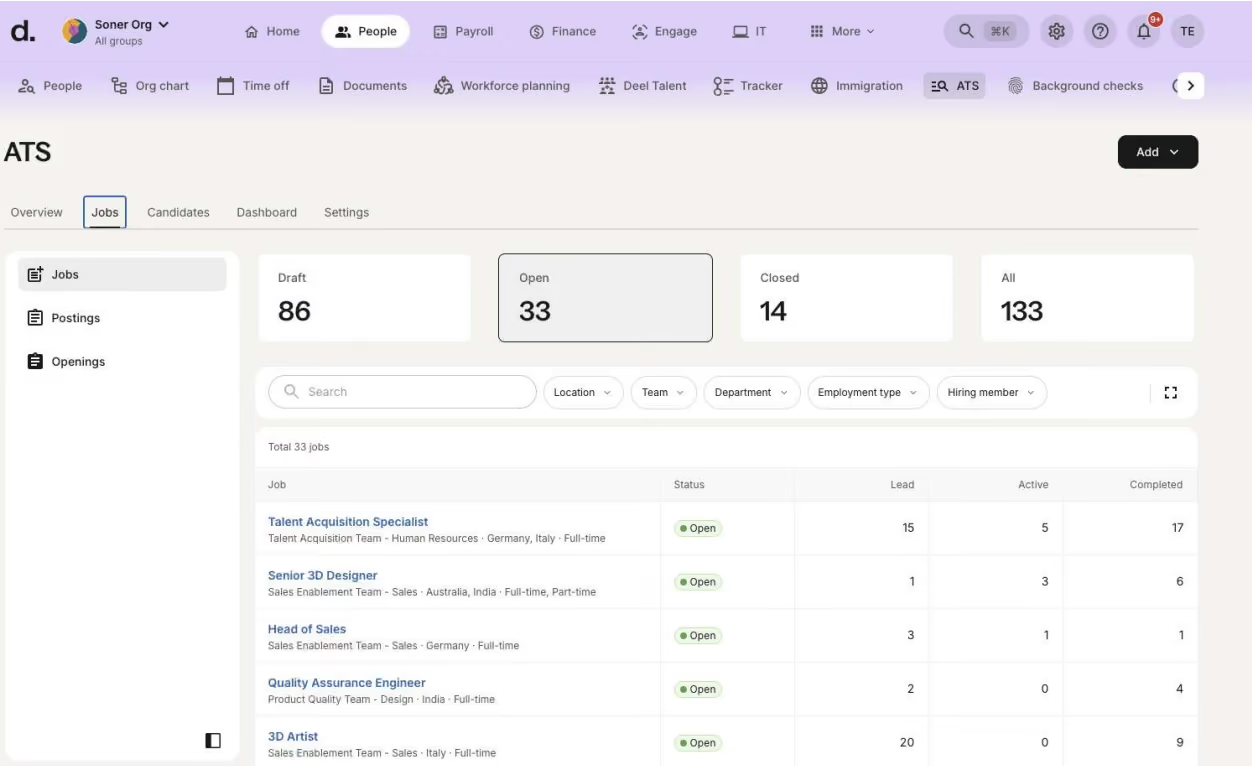
The hiring workflow covers the basics and feels fairly structured. You can set up stages, assign interviewers, and collect feedback in a consistent way. It does take a bit of upfront setup, but once everything is in place, the process is easy to follow. We didn’t run into much confusion moving candidates through stages, and having feedback tied directly to the candidate profile helped keep things organized.
Scheduling and communication are where Deel ATS works particularly well. Because it connects directly with Google Workspace and Microsoft Outlook, you can send emails, schedule interviews, and manage calendars without leaving the platform. We liked that this cuts down on open tabs and the need to copy information between tools. It also helps that email threads, interview invites, and updates are logged automatically, so there is less risk of something slipping through the cracks.
The interview experience is solid. You can assign interviewers, require structured feedback, and review everything in one place. We found the recordings and transcript summaries useful for revisiting interviews, especially when multiple stakeholders are involved.
Deel ATS also offers an AI screening feature where the matching is based only on what candidates submit and how that lines up with the job criteria. It does not try to make decisions for you or pull in outside data. In our view, this makes it feel more like a filtering tool than a full screening system, which some teams will prefer.
To be fair, though, some teams may find Deel’s ATS feature set a bit basic compared to dedicated platforms, especially when it comes to integrations and sourcing. It supports a smaller set of job boards and does not include features like blind hiring or built-in candidate engagement tools. If your hiring process depends heavily on outbound recruiting or more complex pipelines, you may find those gaps fairly quickly.
Another consideration is that the ATS requires Deel HRIS as a foundation, which makes it less flexible if you are only looking for a hiring tool.
40,000+ companies globally.
Deel ATS is custom-priced and requires Deel HRIS (starting at $5/employee/month) as a foundation.
Best For
Companies already using Deel that want to connect hiring with onboarding, payroll, and global workforce management in one system.

Zoho Recruit
Like most Zoho products, Zoho Recruit is affordable and feature-rich. The ATS is a strong choice for small businesses, offering a free plan that provides small teams with access to core tools, including job posting, candidate management, and interview scheduling, without upfront costs.
PROS
- Combines ATS + candidate CRM in one system, giving small teams an all-in-one tool to track applicants and manage relationships.
- Free plan and scalable paid tiers with a 15-day free trial and a 45-day money-back guarantee.
- 24/5 support available.
- ATS + CRM in one platform
- Backed by a company like Zoho, notable for reliability and good customer service.
- 24/5 support
- Priced quite modestly after the free version
- Certain features like video interviews are available as optional add-ons.
CONS
- The free plan is limited to just one active job and 256MB of storage.
- Features like the client portal, mass email, workflow alerts, and API are paid features.
- Integrations, at times, don’t work properly, requiring disconnecting and reconnecting.
- The career site is not fully customizable until past a certain paid plan.
- The free plan only allows 256MB of storage.
- Additional features, such as the client portal, mass email, workflow alerts, and API calls cost extra.
- Some users have complained about the quality of some of the integrations.
- The career site is not fully customizable until past a certain paid plan.

In our testing, Zoho Recruit proved to be a strong ATS option for small businesses that want more than just the basics. While its free plan gives small teams a taste of core functionalities, the paid plans and add-ons ensure the platform scales alongside them as they grow.
Let’s first dive into Zoho’s free plan. It covers the essentials for managing candidates, emails, and interview scheduling. While the customization options are somewhat limited, we were glad to see the ability to post jobs on both free and paid job boards, including the niche ones. Integrating with Google applications and support for 26 languages are definite pluses, making connecting with applicants from different backgrounds easier. Another time-saving feature is the availability of five customizable email templates, which can be a real help. However, the biggest con of the free plan is that you only get one active job at a time. The storage limit is also on the smaller side, set at 256 MB.
On the bright side, creating a career page with customizable templates is straightforward, though it might not be the most visually stunning option out there. Another cool feature we came across is Zia, the AI-based chatbot. It automatically responds to applicants’ FAQs and keeps them updated on job availability and application statuses. Plus, there's a handy automated candidate matching feature: you create a new job and specify the desired skills, and Zoho Recruit will rank the candidates based on how well their resumes meet set requirements.
However, teams need to plan carefully: while the base plans are affordable, important tools like the client portal, workflow alerts, video interviewing, and some integrations come as paid add-ons. We also encountered some occasional integration issues, where we needed to manually reconnect third-party tools to keep workflows running smoothly. Additionally, the career site customization options feel somewhat limited on lower-tier plans, which may frustrate small businesses trying to present a polished employer brand.
Bosch, Deloitte, Saint-Gobain, PWC, Allianz.
Zoho Recruit provides a range of paid plans alongside the free version:
- Standard plan is priced at $30/user/month, offering features such as a document library, analytics, and customizations.
- Professional plan priced at $60/user/month, which includes assessments and social recruiting capabilities.
- Enterprise plan priced at $90/user/month, providing a comprehensive set of features (doesn’t include add-ons).
- Add-ons available include the client portal and video interview modules. Zoho Recruit also offers a 15-day free trial for users to explore the platform's capabilities.
Best For
Zoho Recruit is best for small businesses and small agencies that want a cost-effective ATS and candidate CRM solution with the flexibility to scale.

We use Zoho daily. We manage the application process and track candidate pipelines. We link candidates to open positions and associate them with customers.
Zoho also helps us track customer communication. The CV parsing feature with AI functions simplifies our workflow significantly.
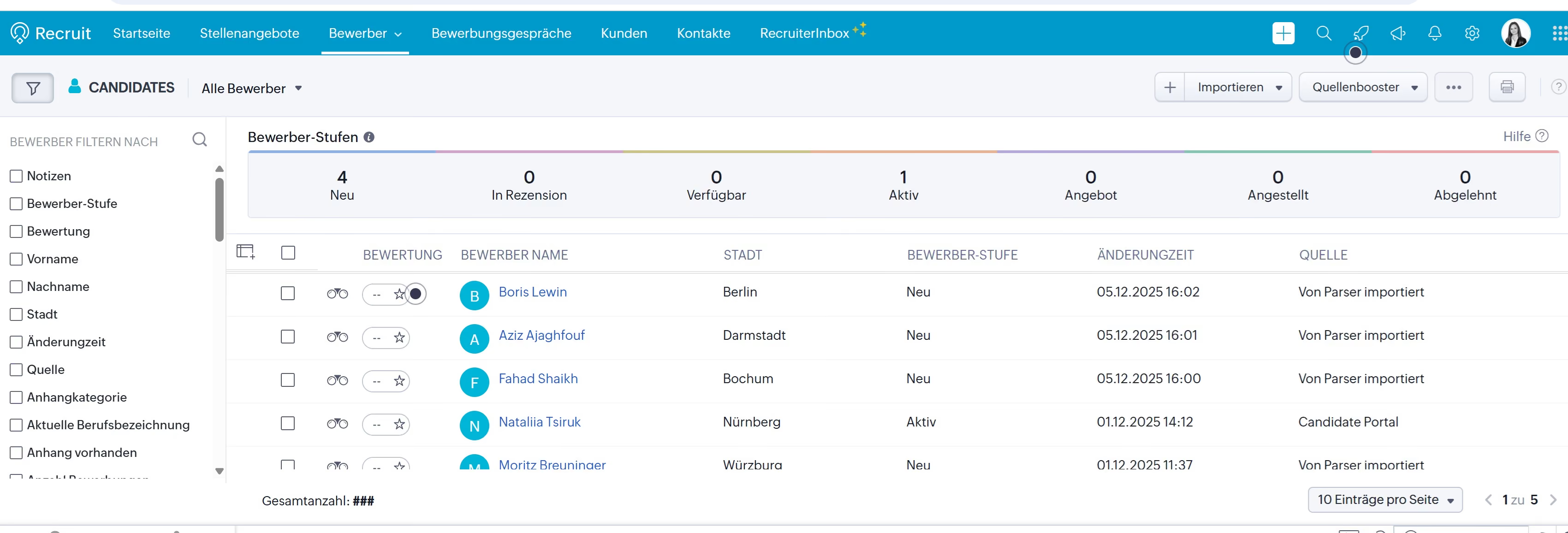
The functionality is unmatched compared to similar products on the market. You get everything in one application. It supports not only recruiting processes but also customer management. The pricing is also very competitive.
We needed a tool to manage our recruiting process. As an IT consulting company, we needed to manage not only candidates but also customers and their projects. Most recruiting tools on the market offer very limited functionality.
Only Zoho could meet all our needs by offering an all-in-one solution at a very reasonable price. The support team has also been extremely helpful.
The wide range of functions can make setup challenging without guidance. If you're not a developer, integrating the application form into external resources is not easy. The automation tools are useful but somewhat difficult to configure. Zoho’s representative partners in Europe can be overly pushy.
It offers significantly more functionality at a better price.
Compare your company’s needs with the tool’s features and pricing. This is the most effective way to determine which tool is the best fit for your situation.
Updates are made regularly. As a user, I’ve noticed that the team is constantly working to improve the service.
Zoho Recruit is well-suited for managing candidates, customers, and contacts—particularly for consulting or recruiting-focused organizations.
Not sure.

Greenhouse
We've long found Greenhouse to be a formidable player in the ATS market, particularly in supporting the growth of SMBs with global operations and/or value-driven, unbiased hiring. Its job boards support 19 languages, while its resume anonymization auto-masks candidates' personal details. Remarkably, it's one of the rare few platforms we've encountered that can parse resumes in 26 languages.
PROS
- Offers access to more than 1,000 job boards.
- Built-in internal mobility, referral programs, and onboarding capabilities.
- Interview kits for structured assessment of candidate skills, traits, and qualifications.
- Resume parsing in 26 languages, job boards in 19 languages, and interviews in 6 languages.
- Resume anonymization removes personal details like photos, names, and gender from resumes.
- Send branded, automated email and text notifications from your company’s domain.
- Over 500 pre-built integrations and an open API for seamless connectivity.
- Greenhouse's onboarding feature is built and executed well. New hires transition smoothly from candidate to employee.
- iOS and Android apps work well for recruiters on the go. Users can review applications, schedule interviews, view candidates' profiles, and more.
- 450+ third-party integrations.
CONS
- While they are suitable for the SMB market, they tend to do better with headcounts of 75+.
- Undisclosed pricing. No free trial is available.
- No monthly subscription option. Higher priced than some competitors.
- Bulk reject and email features are available in the Candidates tab, but not during the application review stage.
- The new UI, released in 2024, has garnered negative feedback from some users, who have found it more challenging to navigate than the previous version.
- Greenhouse’s pricing is undisclosed, and they do not offer a trial version.
- Some users note that reporting customization is quite limited and difficult to navigate.
- In-person/live support could be improved.
Greenhouse is often seen as an enterprise-grade ATS, but based on our testing and experience, it offers several standout advantages that can also benefit small businesses ready to invest in a structured, high-performing hiring system.
For small teams, Greenhouse’s exceptional sourcing reach, with access to over 1,000 job boards, strong internal mobility features, and built-in referral programs. This means that, as an employer, you can utilize the platform’s integrations for external candidate sourcing while making the most of your talent database.
The level of thoroughness and consistency of interview kits we saw in Greenhouse was better than most we’ve tested. They’re structured in a way that helps hiring teams assess not just skills, but candidate traits and qualifications.
Additionally, if you’re hiring people across the globe, like us, you’ll appreciate this vendor's language inclusion. It handles resume parsing in 26 languages and job postings in 19 languages, with the ability to conduct interviews in 6 languages. That’s far beyond what we’ve seen from most other ATS platforms.
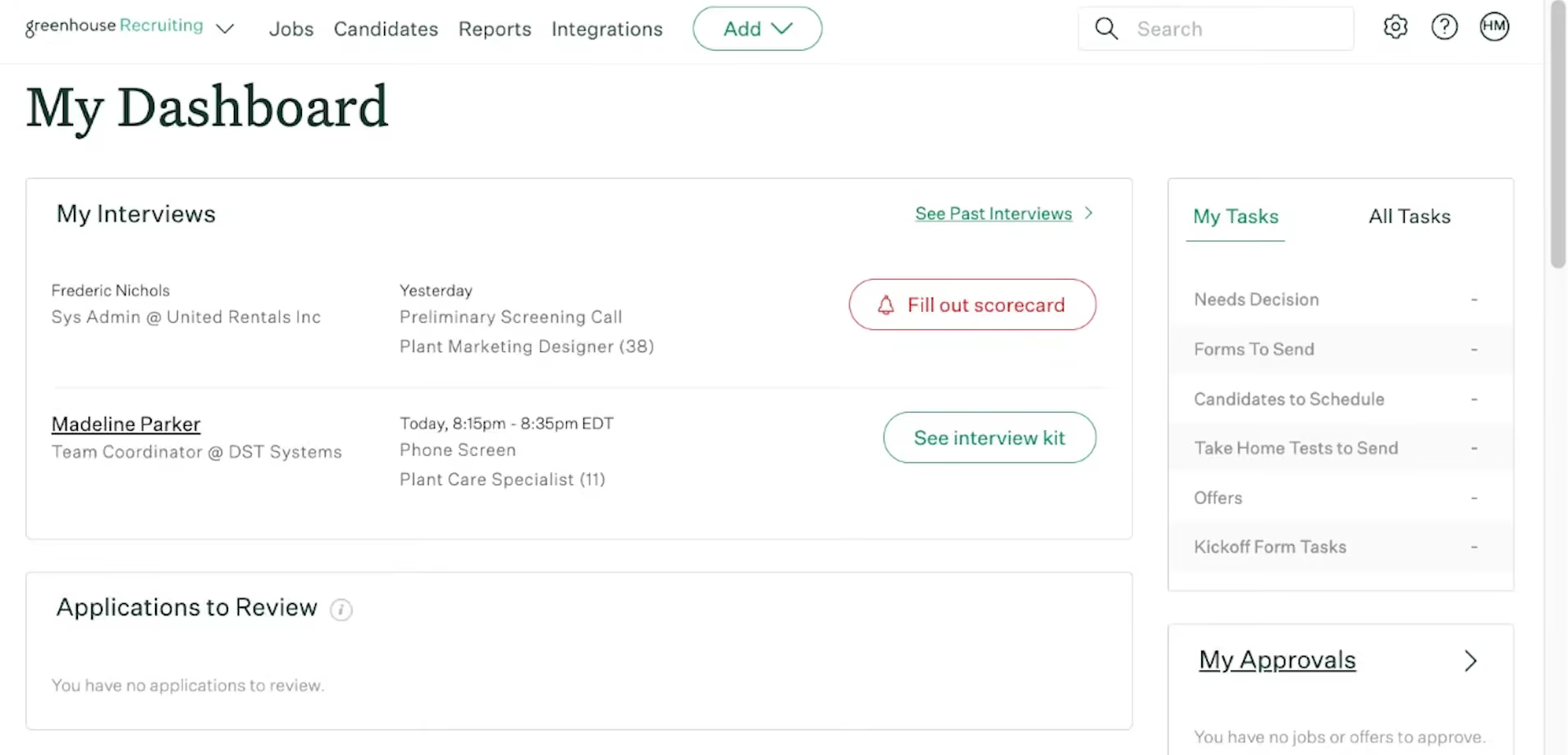
We also thought the resume anonymization feature was very useful. It removed applicants' personal details such as photos, names, and gender so we could focus on the qualifications that matter most.
Integration-wise, Greenhouse offers over 500 pre-built options, plus an open API, so it’s quite reassuring that the ATS can fit smoothly into almost any existing HR tool.
However, Greenhouse's pricing is a bit of a mystery and, from what we've seen, not as budget-friendly as other options like Loxo or Manatal. There is no free trial, and no monthly billing option. For a small team of 10, it could cost over $6,000.
The platform has also recently updated its user interface. Sadly, it didn’t get very positive feedback from users, and we can see why. Compared to the previous design, this version somehow requires more clicks to perform certain actions, such as sending an interview self-schedule. Thankfully, Greenhouse does offer the option for users to go back to the old UI under their account settings (which was just what we did).
Another inconvenience we’ve noticed is the absence of bulk rejection and email features during the application review stage. While these features are available in the Candidates tab, we trust having them in the initial review process would streamline things a bit more.
6,500+ companies, including Evernote, Nerdwallet, and Coursera.
Undisclosed.
Best For
Regarding their SMB offering, Greenhouse is best paired with growth-focused organizations. Those burgeoning companies hiring at volume and operating internationally, while small, stand to make the most out of this ATS.

I used Greenhouse regularly to manage the full talent acquisition process from start to finish. I created requisitions and routed them for hiring manager approval, confirming that key details such as salary range, department, assigned client, location, and target start date were aligned before roles were posted.
Greenhouse allowed us to post roles once and automatically distribute them to multiple job boards, centralizing all applicants in one place for screening and review.
I customized recruitment workflows to provide hiring managers and candidates with clear visibility into each stage of the process.
The platform’s structured interview kits and stage-specific evaluation questions guided hiring managers and subject matter experts during interviews and supported consistent feedback. Automated reminders prompted interviewers to complete evaluations on time, which helped keep hiring moving forward.
For high-priority or executive roles, we relied heavily on Greenhouse’s shared candidate profiles and consolidated feedback view, allowing decision-makers to compare evaluations and align on final hiring decisions.
Having approvals, communication, feedback, and documentation in one system made Greenhouse the central hub of our talent acquisition process.
- Documentation – Greenhouse allows teams to document and extract critical talent acquisition data such as requisition aging, candidate volume and quality, interview feedback, salary expectations, approvals, and requisition status, supporting progress tracking, bottleneck identification, and effective time management.
- Communication – Greenhouse centralizes hiring manager and SME discussions within each candidate profile and automates standardized updates, supporting consistent feedback, clear communication, and a positive candidate experience without candidates feeling ignored.
- Customization – Greenhouse offers user-friendly customization without requiring extensive training, and its role-specific interview templates and workflows provide clear guidelines that support consistent and effective screening and interviewing.
We implemented Greenhouse because we were hiring across multiple global branches for overlapping and diverse roles, and our existing processes made collaboration, candidate tracking, and feedback inconsistent.
We needed a centralized system that could support hiring at scale while allowing teams in different locations to work together efficiently.
Greenhouse allowed us to easily reprofile candidates, endorse them to the appropriate subject matter experts regardless of location, and collect structured feedback from hiring managers and interviewers, including skills test results.
The platform also helped us automate the candidate experience, from application questions and interview scheduling to status updates and job offer management, significantly reducing manual work for recruiters while improving communication with candidates.
Since all activity and feedback were documented in one system, we were able to extract clean, reliable data for quarterly and annual talent acquisition reviews, which helped identify process improvements and recruitment wins.
I was part of the team that implemented our ED&I initiatives, and Greenhouse supported this by allowing us to omit bias-prone details such as age, gender, and graduation dates during early-stage screening. It took time to fine-tune which fields could be removed versus which were non-negotiable, but the flexibility of the platform made it easier to build a more inclusive and consistent hiring process.
I personally used Greenhouse for more than one year in a hands-on recruiting and implementation role.
- Cost – Greenhouse can be expensive compared to other ATS options, and a utilization dashboard showing which features are actively used versus underutilized would help teams manage costs more effectively.
- Recruitment Focus Only – While Greenhouse performs well for talent acquisition, extending functionality into a full HRIS would allow recruitment and core HR processes to exist in one platform.
- Reporting and Dashboards – Reporting is powerful, but additional customizable dashboards would make it easier to present insights directly within the ATS without exporting data to Excel or creating separate presentations.
Compared to other ATS tools I have used, Greenhouse stands out due to its usability, flexibility, and balanced structure. Having all activity documented at each stage supports accurate reporting and saves time when pulling data for updates or analysis.
The approval workflow for budgets and offers is particularly effective in larger organizations, as approvers can be assigned directly and the system manages follow-ups automatically.
Key criteria include the number and complexity of open roles, overall hiring volume, and the size of the recruitment team. Greenhouse works best for organizations with high hiring demand, complex recruitment processes, and multiple recruiters and hiring managers involved.
For smaller teams with simpler hiring needs, a more basic and cost-effective ATS may be a better option. The higher cost of Greenhouse is best justified when roles require customization, multiple approvals, and cross-functional collaboration.
I used Greenhouse for just over a year, and during that time the platform continued to evolve in response to user needs.
One improvement I valued was the introduction of ED&I features that allow teams to hide information that could introduce bias during screening. This supported our internal ED&I initiatives and improved early-stage candidate evaluation.
Greenhouse is a strong fit for fast-paced, highly technical organizations such as technology and software, creative and digital, AI and machine learning, and fintech companies.
Greenhouse may not suit organizations such as construction, hospitality, moving, or logistics companies where roles are primarily non-technical, hiring processes are straightforward, and workflows are repetitive.

100Hires
We found 100Hires a practical option for organizations that need to source, engage, and track candidates without investing in a broader talent technology stack. Small businesses, startups, and recruiting agencies are likely to benefit most, particularly by how this tool helps them avoid stitching together multiple recruitment platforms.
PROS
- No formal implementation required, up and running in minutes
- One-click posting to 100+ job boards
- Chrome extension for direct LinkedIn and GitHub candidate import
- Built-in sourcing and automated outreach & follow-up sequences
- AI tools for candidate ranking, job descriptions, interview questions and communications
- Strong duplicate management and GDPR compliance controls
- 14-day free trial, no credit card required
- No formal implementation required, up and running in minutes
- One-click posting to 100+ job boards
- Chrome extension for direct LinkedIn and GitHub candidate import
- Built-in sourcing and automated outreach & follow-up sequences
- AI tools for candidate ranking, job descriptions, interview questions and communications
- Strong duplicate management and GDPR compliance controls
- 14-day free trial, no credit card required
CONS
- Limited reporting compared to mid-market and enterprise ATS platforms
- Video interviewing is not native (available via Zoom integration)
- SSO restricted to higher-tier plans
- Interface prioritizes function over visual polish
- Not suited for complex approval processes or compliance-heavy organizations
- Limited reporting compared to mid-market and enterprise ATS platforms
- Video interviewing is not native (available via Zoom integration)
- SSO restricted to higher-tier plans
- Interface prioritizes function over visual polish
- Not suited for complex approval processes or compliance-heavy organizations
100Hires takes a different approach from most applicant tracking systems built for small businesses. While competitors like Workable or Breezy HR focus primarily on managing inbound applicants, 100Hires bundles sourcing, outreach, and tracking into a single platform. For a two-person recruiting operation that can't justify separate subscriptions for a sourcing tool, a recruiting CRM, and an ATS, that's a meaningful distinction.

Setup is fast. During our review, we created an account, connected a Gmail inbox, and had a live job posting syndicated to LinkedIn and Indeed within about 20 minutes, with no implementation call required.
The sourcing infrastructure is the platform's clearest strength. Job postings can be distributed to more than 100 boards simultaneously, and the Chrome extension lets recruiters pull candidates directly from LinkedIn or GitHub profiles into the pipeline without switching tabs. We also appreciated several practical administrative controls that are easy to overlook until they become necessary, such as automatic candidate merging when duplicate email addresses or LinkedIn profiles are detected.
100Hires’ AI features have matured notably over the past two years. The platform now generates job descriptions, interview questions, candidate summaries, and salary benchmarks. The most operationally useful addition is candidate scoring. Rather than reviewing resumes in the order they arrived, recruiters can sort the applicant list by AI-generated score and work from the top down. Whether you trust the ranking enough to skip low scorers entirely will depend on your role and risk tolerance, but for a 200-applicant pool, the functionality can help with prioritization.
However, we found the analytics fairly limited beyond standard metrics. Reports cover candidate sources, time-to-hire, disqualification reasons, and nurture campaign performance, yet they’re presented as separate views rather than within a centralized dashboard. From our tests, it also doesn’t seem that users can build custom reports or create tailored visualizations without exporting data to spreadsheets or external BI tools, which may not be a cup of tea for teams that present hiring metrics on a regular basis.
Integration depth follows the same pattern. The core recruiting stack is well covered across job boards, calendar, email, and video interviewing, but native connections to HRIS and payroll systems are thin. If your organization runs on Workday, ADP, or a similar enterprise platform, expect to rely on Zapier or a custom API build rather than a pre-built integration.
The interface is undoubtedly easy to use, though it's more functional than polished. Compared to Pinpoint, which invests noticeably in visual hierarchy and interaction design, 100Hires feels utilitarian. That's unlikely to be a deciding factor for most buyers, but worth knowing if your team spends eight hours a day on the tool.
100Hires serves more than 5,000 companies across 150+ countries, including G42, EXANTE, Argano, and Memgraph.
100Hires features four annual billing plans: Start ($49/month for 3 jobs/1 user), Advanced ($199/month), and Pro ($399/month). AI features are available across all plans, while the Pro tier adds contact enrichment, an email carousel, and warm-up features for higher-volume outreach. Custom Enterprise pricing covers SSO and dedicated management. All tiers include a 14-day trial with no credit card required.
Best For
Lean recruiting teams that need sourcing and tracking in one place and don't require deep HRIS integrations or advanced analytics.
Kula
We picked Kula for its AI-native, all-in-one approach: it folds sourcing, scheduling, AI-enhanced interview intelligence, and candidate scoring into a single ATS with flat headcount-based pricing, a strong fit for lean teams replacing a patchwork of tools.
PROS
- All-in-one: sourcing, CRM, scheduling, AI notetaker, and analytics in one ATS, with no add-ons or per-seat fees.
- Native AI notetaker auto-records interviews, writes summaries, and fills scorecards inside the candidate profile.
- AI scoring stack-ranks applicants against your own criteria and shows the reasoning behind each score.
- Flat, headcount-based pricing that scales with company size rather than seats.
- Fast migration from legacy systems; customers report going live in roughly three weeks.
- Native AI notetaker records, summarizes, and auto-fills scorecards inside the candidate profile, no separate tool to integrate.
- Transcripts and notes live in the ATS, so you can compare a candidate across every interviewer in one place.
- Customizable scorecards with structured, AI-assisted feedback to reduce bias in evaluations.
- Bundled into a full ATS with flat headcount-based pricing, removing per-seat interview-intelligence fees.
- AI scoring stack-ranks applicants against your criteria and shows the reasoning behind each score.
CONS
- Reports, candidate-templates, and filtering customization still feel somewhat limited, though the team is actively expanding it.
- Interview coaching and analytics are lighter than dedicated tools like Metaview or BrightHire, since this is one module of a broader ATS.
- As a newer platform, it has occasional bugs and minor performance issues.
- Less depth on interviewer coaching and analytics than dedicated tools like Metaview or BrightHire.
- Customization for reports, candidate templates, and filtering options still feels somewhat limited for users, but it’s something the team is continuously addressing.
- As a newer platform, it has occasional bugs and minor performance issues.

We first came across Kula as a sourcing automation tool, so we were keen to see how far it had moved. The founder, an early recruiter at Stripe and Uber, built the platform around how recruiters actually work, and 18 months ago it went live as a full applicant tracking system covering everything from opening a requisition through to the offer. For a lean team, the appeal is consolidation: sourcing, scheduling, AI interview notes, and analytics sit in one place rather than across, let’s say, an ATS, a sourcing tool, and a calendar scheduler.
That said, what stood out most in our demo was the native AI notetaker. Unlike interview intelligence tools that are built to integrate with an existing ATS, Kula can record each interview, write the summary, and auto-fill the scorecard inside the candidate profile. The team behind health benefits platform Plum told Kula their hiring managers were "fascinated" by it, and it was easy to see why in our walkthrough. As another analyst put it, they’ve essentially brought a product concept like Brighthire’s into an ATS.
Furthermore, the headcount-based pricing is a sensible fit for SMBs, since you pay by company size rather than per seat. We also liked the AI scoring, which stack-ranks applicants against criteria you define and shows the reasoning behind each score rather than a bare number.
That said, Kula is still a young company and a new product. While they seem to be covering a lot of ground fast, reporting is a common complaint among users, who cite limited depth and no stage-by-stage funnel view. There is no resume parsing yet, and occasional bugs surface during use. For teams that want to be on the cutting edge of AI hiring, though, those are tradeoffs worth weighing.
Kula serves 220+ companies, including DeepScribe, Healthie, Plum, Dapper Labs, Vidyard, and CleverTap.
Kula uses all-inclusive, headcount-based annual pricing with every feature included and no per-seat fees or usage credits. Custom pricing applies above ~100 employees, and a free trial is available after a demo.
Kula launched in 2021 as a sourcing and outreach automation tool and, 18 months ago, relaunched as a full AI-native ATS spanning the entire hiring lifecycle. Recent additions include the AI notetaker, AI scoring, conversational analytics, built-in scheduling, and a Kula API and MCP for AI agents.
Best For
Kula is best for SMB and mid-market in-house teams that want to consolidate sourcing, tracking, scheduling, and interview intelligence into one AI-native ATS with predictable pricing.

HigherMe
HigherMe is designed around the reality of hourly hiring. Rather than asking small-business managers to learn a complicated recruiting system, the platform tries to automate the repetitive parts of hiring. You can post a job, collect applications, screen candidates, schedule interviews, and move new hires into onboarding without constantly switching between systems.
PROS
- Built specifically for high-volume hourly hiring
- AI-powered candidate screening and ranking reduces manual resume review
- Posts jobs across major job boards from a single dashboard
- Mobile-first application experience with an 88% reported completion rate
- Automates interview scheduling, reminders, and candidate follow-up
- Connects hiring with onboarding, background checks, E-Verify, and payroll
- Managers can run both inbound and outbound recruiting campaigns using the tool’s text-to-apply or talent pool features. Thereby creating a diversity of talent and strategy.
- HigherMe can generate physical posters with QR codes on them, which can be printed and posted in strategic locations.
CONS
- Available in the U.S. and Canada, not globally
- No built-in features for candidate relationship management or employee referrals.
- Not a good fit for businesses primarily hiring professional, technical, or salaried employees
- Though the system offers several candidate screening features, they are fairly basic and mostly question-based.
- Most of the tasks within the typical pre-screening process can’t be automated, so the platform does need a considerable amount of manual involvement from recruiters.
HigherMe stood out to us because it’s built specifically for small businesses doing hourly hiring, and that focus shows in how the platform handles everything from job posting to onboarding.
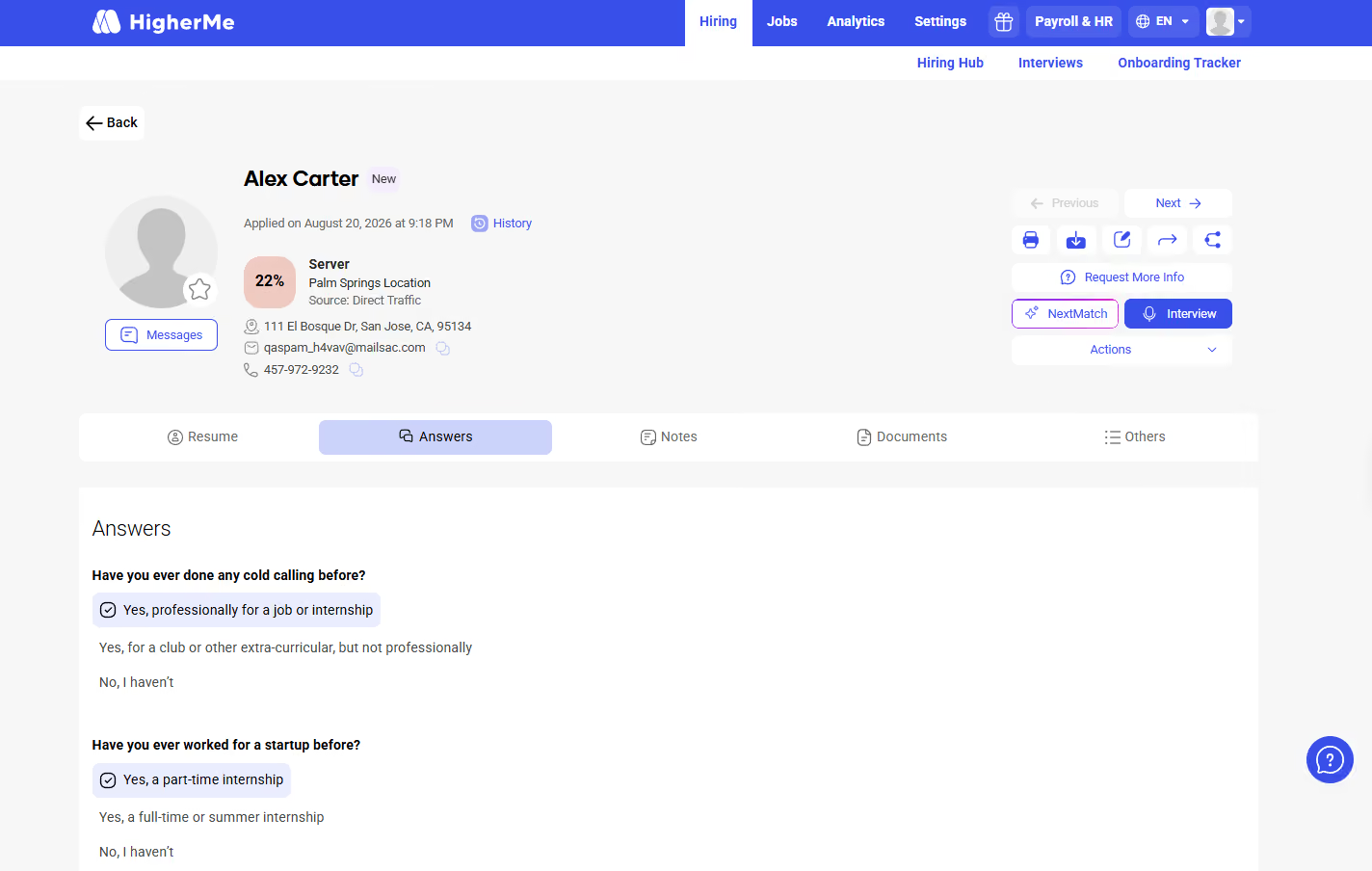
From one dashboard, businesses can distribute openings across Indeed, ZipRecruiter, LinkedIn, Jobcase, Talent.com, and others. Applications then flow back into the same HigherMe pipeline, so managers don't have to keep jumping between different job board accounts.
Hourly employers often have positions open continuously, so keeping jobs visible can become another small administrative task, and HigherMe handles that automatically with its automated reposting tool.
Businesses can customize application forms with their own screening questions, branding, logo, colors, and messaging. The ATS also seems to understand that small businesses don't have much patience for complicated implementation projects, so it ensures most locations can go live within a day, with job templates, job board integrations, Text-to-Apply, and application flows configured through the platform.
Once applications start coming in, you can make use of HigherMe’s AI-powered screening and Candidate Score for applicant prescreening. Particularly, NextMatch AI can conduct candidate interviews, score applicants, and provide users with a ranked shortlist.
Then, the interview scheduling automation ensures candidates can choose available interview times on their phones, receive automated reminders, and reschedule without requiring a manager to coordinate every change. The ATS also supports phone, video, and in-person interviews, as well as multiple interview rounds and timezone-aware scheduling.
That said, HigherMe isn't designed as an advanced video interview platform. We didn't find features such as round-robin interviewer assignment, sophisticated workload balancing, or detailed interviewer scorecards and feedback loops.
We wouldn't recommend this ATS either if robust resume parsing is a must. While HigherMe can capture candidate resume info and screen applicants against custom questions, it lacks search capabilities for work history, education, certifications, or specific skills. There’s also no CRM or automated data enrichment you’d see in top general-purpose ATSs.
Domino's, Tim Hortons, Dunkin', Chick-fil-A, Eggs Up Grill, Applebees, Kona Ice, A&W
HigherMe pricing ranges from $89 to $99 per location per month. No free trial available.
Best For
U.S.- and Canada-based small and multi-location businesses that primarily hire hourly employees, particularly restaurants, quick-service restaurants, retail, hospitality, and franchise businesses.

Pinpoint
While often seen as a tool for mid-sized and growing companies, we found Pinpoint to be a strong fit for small businesses with ambitious growth plans. It combines an intuitive ATS with a built-in talent CRM, robust automation workflows, and customizable career sites.
PROS
- Pinpoint’s ATS is highly customizable and values collaborative hiring.
- Pinpoint offers unlimited active jobs, team members, external recruiters, training, and support for all users regardless of their plans.
- The customer support team is helpful and responsive to customers’ requests.
- The pricing is transparent. Startups with under 50 people can benefit from its discounted pricing.
- It’s got a robust career site builder you can easily customize without the help of IT.
- It provides over 100 third-party integrations. Also offers custom integrations (but only for Enterprise plan).
- Pinpoint is an agile ATS that is highly customizable and values collaborative hiring.
- It’s got a simple and transparent pricing structure.
- Pinpoint offers unlimited jobs and team members in all of its plans.
- Their customer service team is highly praised by users.
- The career site builder is very robust, allowing teams to attract and convert the right talent.
- There are over 100 HR software integrations to choose from, and Pinpoint’s team is adding 3-5 every month.
CONS
- Pinpoint offers its employee onboarding module with additional fees.
- It can be expensive for budget-minded teams.
- Multilingual support is only available for the Enterprise plan.
- The employee onboarding module does cost extra.
- It isn’t the best fit if you’re looking for the cheapest ATS.
- There free trial is only available upon request.
Pinpoint's applicant tracking system is highly regarded by users for its intuitive interface, neat automation workflows, and robust career site builder, which we found perfect for small businesses to create a polished, professional hiring process.
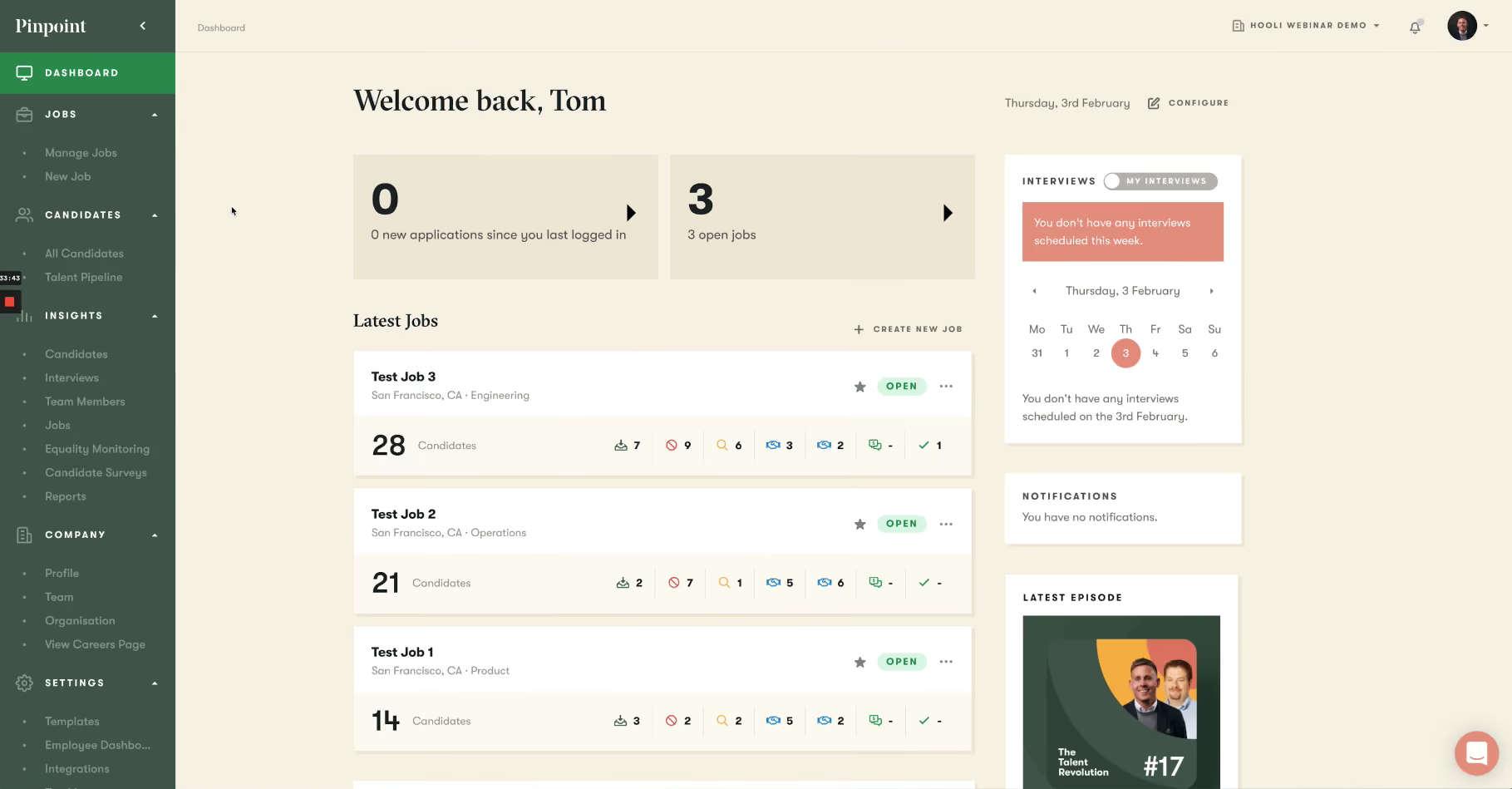
We love how easy it is for candidates to apply through the career site. Here’s an example of what going the extra mile looks like: if your candidates are not ready to apply, they can opt into a talent community to stay in touch with your company. After testing a few dozen vendors, we can confirm this is something you can’t find in most other ATSs.
We were also impressed by Pinpoint’s customer service. Regardless of the plan you opt for, you will get a dedicated success manager, concierge onboarding, and unlimited support via phone, email, and live chat. There really isn’t anything we dislike about it.
Just a few things to keep in mind, though. There’s no free trial or free plan to try before buying. And when compared with other solutions, Pinpoint tends to be more expensive than some small-business-focused competitors, with the cheapest plan costing $345 per month. If you’d like to use its onboarding module, you need to purchase it separately.
We should also warn you that although Pinpoint has a considerable number of native integration options, its bespoke integrations are only available to Enterprise plan subscribers with a minimum of 150 employees.
300+ companies, including CoinShares, Pathways Global, Grant Thornton, Icario, and Pivot Energy.
Pinpoint offers a Growth plan starting at $345 per month and an Enterprise plan starting at $1,200 per month, both with annual billing. Startups with under 50 employees may be eligible for Pinpoint's startup program.
Best For
Pinpoint is a good choice for small in-house recruiting teams that value a polished, candidate-friendly ATS with exceptional customer support.

We have configured a recruitment process and attached email templates to every stage of it, allowing us to rapidly communicate with candidates in a standard way, at all stages. We share CVs with management within the tool and capture feedback. We use the tool to invite candidates for assessments, and for booking the assessments in [usually via MS Teams which PinPoint integrates nicely with]. We upload interview notes to the candidate area in PinPoint, and sometimes make a phone interview guide within the tool, to enable us to use a more robust scoring mechanism if anticipating higher volumes of direct applications.
Pinpoint is also used to store/bank candidates for future roles. We have created and implemented a bespoke tagging approach to find people quickly. We have also tagged candidates for reasons not to progress, and can report on that. This gives an opportunity to fine-tune adverts for future positions if we uncover particular rejection themes. It is also used for reporting on things like the diversity of applicants and candidate volume.
It is very easy to use from a product owner and user perspective. Both management AND suppliers have happily adopted PinPoint and only have positive feedback about it. The PinPoint support staff/messaging tool is also fantastic, with immediate responses provided to any tickets raised.
I love the ability to make bespoke application form questions. Knowing clearly candidate availability, salary expectations, and right-to-work status from such questions saves the recruitment team countless hours.
With the right process and email template set, it gives a better candidate experience. Candidates receive rejection emails and will know clearly what to expect at the interview/assessment stages.
The reporting is wonderful. You simply cannot report on diversity matters without a system like PinPoint, which removes the candidate’s personal info from their actual job application.
Our global recruitment function was hiring around 60+ people a year, across multiple global locations. We used various channels and suppliers to generate candidates but had to manage everything via email and Excel trackers. We wanted a solution that was easy to use, configurable, and enabled HR and management to collaborate, in line with our values. We also wanted a solution that enabled blind CV applications to mitigate unconscious bias, plus diversity reporting. We have used it since April 2022.
You can't effectively share comms with recruitment suppliers about new openings or changes to vacancy briefs, so I am still relying on emails. There should be a ‘vacancy supplier’ area on each vacancy where we can communicate with agencies and also document any feedback from them from the market. Then we could have an option to share info with leaders.
- The way it can be configured to your needs is refreshing.
- The general speed of moving candidates around within a process or into a new process is also different from other systems.
- In a recruitment team, everyone can see what is going on with candidates and roles, so you remove bottlenecks and enhance efficiency when it comes to things like recruitment team absence.
- First, make sure you have an agreed recruitment process established in the business, then create a ‘shopping list’ of problems to solve or features you would like. Then review solutions.
- Ensure you liaise closely with IT and/or infosec/GDPR managers around the idea and implementation.
- Finally, these systems are priced based on an organization’s headcount, so that may come under consideration from a budget perspective.
A few enhancements here and there, mostly around the reporting suite.
Firms recruiting high volume roles and varied roles, with many different managers/suppliers involved.
Pinpoint would be helpful for any business, regardless of size of industry.

JazzHR
Purposely built for teams with less than 500 employees, JazzHR provides almost every key feature of an ATS, like career pages, employer branding, candidate sourcing, and talent CRM, at a transparent and affordable price. Free trials are also available.
PROS
- JazzHR is quite affordable and doesn’t place any limits on the number of users added. It also offers a free, 21-day trial that anyone can sign up for.
- It’s got built-in features for offer management. You can choose from existing offer letter templates or create your own and share them with successful candidates.
- You can automate triggers for candidates to be automatically notified via email when their application has moved a stage further in the hiring process. Several other email responses can be automated.
- JazzHR is quite affordable and doesn’t place any limits on the number of users added. It also offers free, 21-day trials that anyone can sign up for.
- JazzHR has built-in features for offer management. You can choose from existing offer letter templates or create your own and share them with successful candidates
- You can automate triggers for candidates to be automatically notified via email when their application has moved a stage further in the hiring process. Several other email responses can be automated.
CONS
- Some users reported a learning curve with JazzHR's UI and that it took them some time to get used to it.
- Although a product geared towards SMBs, it lacks a free plan. We mention this as a con since other SMB-geared recruiting products often do offer free-forever versions, which puts JazzHR slightly behind the competition.
- Several users have mentioned that the reporting feature is difficult to use, with very little room for report customizations.
- JazzHR currently lacks a mobile app, and the browser version isn’t well-optimized for mobile use.
- Some users reported a learning curve with JazzHR's UI and that it took them some time to get used to it
- For a product geared towards SMBs, it lacks a free plan. We mention this as a con since other SMB-geared recruiting products do offer free-forever versions, which puts JazzHR slightly behind the competition.
- Several users have mentioned that the reporting feature is difficult to use with very little room for report customizations.
- JazzHR currently lacks a mobile app, and the browser version isn’t well-optimized for mobile use.

JazzHR delivers a solid mix of affordability, core ATS functionality, and scalable features that we believe are perfect for meeting the evolving needs of growing SMBs.
One of its biggest advantages is that it places no limits on the number of users, a huge plus for small businesses that want to loop in hiring managers, interviewers, or stakeholders without worrying about stacking up per-user fees. We also liked how job postings across multiple boards are simple and efficient, helping small teams maximize reach without extra software.
You can start with the lowest-priced plan (Hero) that includes essential features like posting up to three job openings and then upgrade to higher plans as your company grows, ensuring you don’t pay for features you don't need. The other two plans (Plus and Pro) have more advanced features for automating, customizing, and analyzing the hiring process.
Unlike some competing SMB-focused ATS platforms, however, JazzHR doesn’t offer a free-forever plan, which we see as a significant downside, particularly for very small teams looking to start lean. Several users we spoke with also noted the UI can feel clunky at first, with a steeper learning curve than some more modern, plug-and-play systems.
JazzHR has been used by over 10,000 businesses to date, including TED, Fox Dealer, Clearly, Massaro, and Heath Ceramics.
JazzHR has three plans. When billed annually, these plans cost as follows:
- Hero: $75 per month for unlimited users and 3 open jobs.
- Plus: $269 per month for unlimited users, unlimited open jobs, ATS, interviews, and assessments.
- Pro: Custom pricing for everything from Plus, along with offers and e-signatures, reporting, and all-access support.
Best For
JazzHR is specifically built for teams at organizations with 5 to 500 employees, regardless of industry or recruiting maturity.

I used JazzHR daily as the primary platform in my role as a recruiter. I primarily used it to receive candidate applications from the career site and job boards. We also used the platform to share resumes and applications with hiring managers and to schedule interviews.
Candidates were moved through the hiring process accordingly, and all hiring managers had visibility into the positions and applicants. The career page was also used to receive applicants directly from the company website.
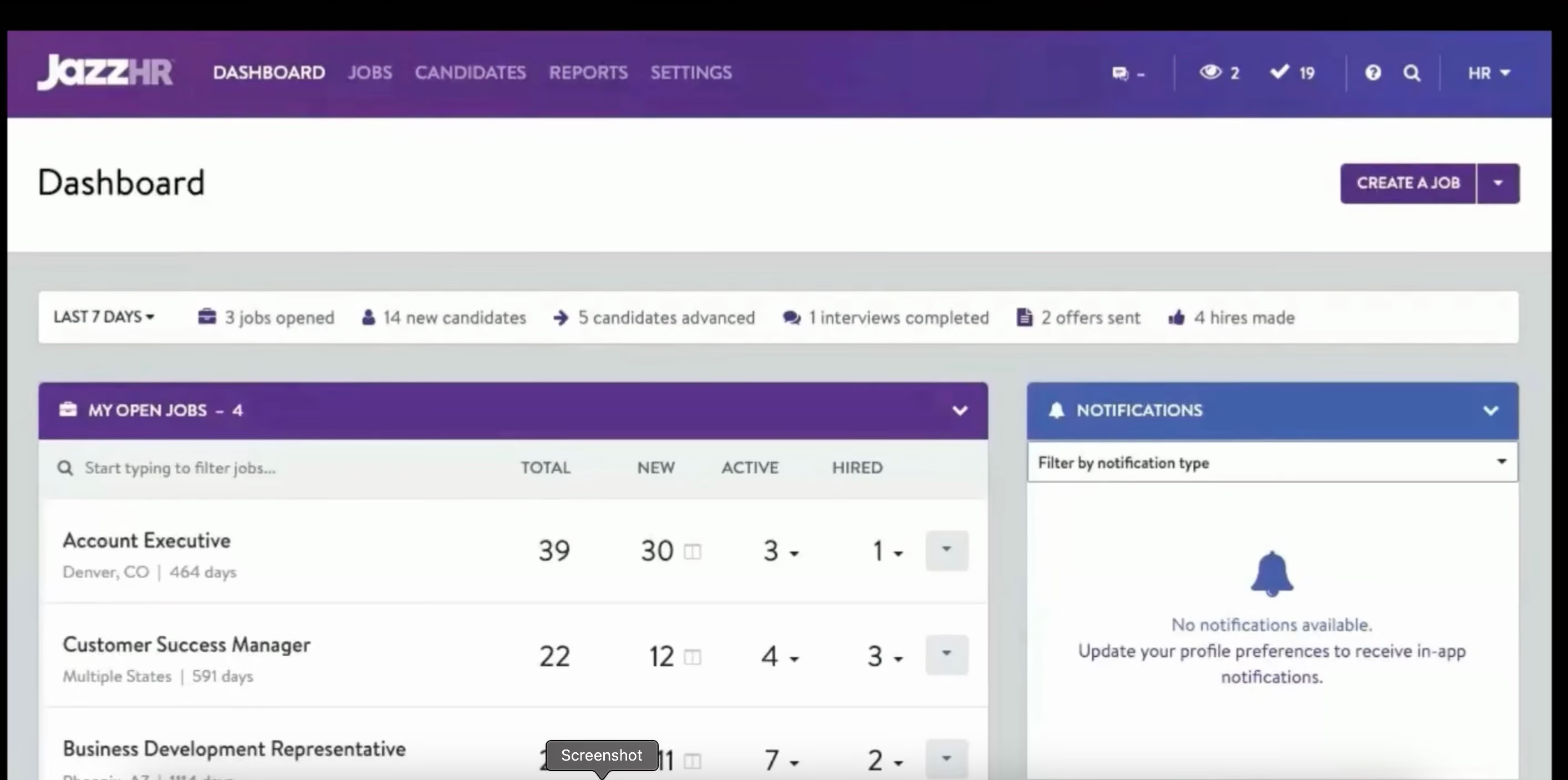
- JazzHR is a simple hiring platform that is easy to understand.
- The user interface is clean and easy to navigate.
- It supports the basic functions of hiring for teams without much experience in recruiting or using ATS software.
I was consulting for a company in HVAC and transportation that needed to increase its headcount substantially for a project. We needed software that was simple for hiring managers to use. Since the hiring managers had limited experience with recruitment, more complex ATS programs were not a good choice.
JazzHR had a decent number of job board integrations and was easy to understand. Building workflows in the system was reasonably straightforward. I used this platform for about two years during this project.
- It’s difficult to manage multiple hiring managers who lack recruitment experience.
- When hiring for multiple locations, job postings can become confusing, especially if the titles are too long.
- There are not enough filters to sort through previous applicants effectively.
JazzHR is suitable for basic hiring projects. It’s very easy to get started and is simple to understand, especially for users without much experience in recruitment or talent acquisition.
Consider your level of experience with applicant tracking systems. If you have limited experience with recruiting and using an ATS, this software will likely suit your needs. If your hiring process is complex, a more advanced system may be a better fit.
JazzHR now offers several add-on features such as texting and digital signatures. It also has a wide range of integrations with other HR programs, which are helpful for hiring and onboarding.
JazzHR is ideal for small-to-medium-sized businesses hiring for basic roles. It works well for organizations without a dedicated hiring expert.
JazzHR is not suitable for organizations focused solely on recruitment, such as recruitment consultancies or agencies.

Teamtailor
Teamtailor’s biggest selling feature is its career page, which is well-built and so easy to navigate. The SMB-focused ATS platform also features elements that promote diversity, equality, and inclusion throughout the hiring process. Plus, free trials are available, and they don’t require your credit card details.
PROS
- Teamtailor is a straightforward ATS that is mobile-friendly.
- Drag-and-drop career site builders.
- Built-in tools to support diversity, equality, and inclusion DEI initiatives.
- Customer support and the help center are notably good.
- Offers one simple plan with unlimited job postings, candidates, and users.
- Free trials are available; no credit card is required.
- Teamtailor’s ATS comes with a robust career site builder that’s also easy to use. It works with drag and drop - no coding knowledge necessary.
- Teamtailor backs several features that support diversity, equality and inclusion (DEI), including anonymous hiring, equal employment opportunity (EEO) surveys, etc..
- Teamtailor is highly rated for their ease-of-use. It’s quite simple to post and promote jobs through their platform.
- There is really in-depth and intuitive help documentation for this solution
CONS
- Their analytics module isn’t very easy to adjust.
- No offerings for other core HR tools
- Features for customization and video interview could be improved.
- Lacks pricing transparency.
- Teamtailor’s analytics are good, but enterprise clients need to use BI Connectors to build the reporting they need. Right now, you can’t sport data from the system. This is particularly important for companies with 500+ employees, or those who have many different locations or franchises.
- Analytics doesn’t allow recruiters to see their cost per hire, which is a really impactful metric
- While they offer integrations with HRIS, onboarding, etc - they have focused on just being a really good ATS now.
- There are predefined user access levels, but you cannot define your own user access levels which is important, especially for the largest companies.

Teamtailor’s ATS has a unique approach to talent acquisition, which pays a lot of attention to how your company presents itself to candidates.
In our assessments, we found that the platform’s drag-and-drop career site builder is one of the best in class for SMBs: it allows small teams to create sleek, attractive, and mobile-friendly career pages without needing design or coding skills. This kind of polished first impression is a huge advantage for small businesses trying to stand out in a competitive talent market.
Another way TeamTailor differentiates itself from the pack is how the platform structures its pricing. It’s a single plan with all features included, and thus, this plan's pricing adapts to your company's size. We are also huge fans of the vendor’s all-inclusive plan, which offers unlimited jobs, candidates, and users, making it easier for small companies to scale without worrying about per-seat costs or feature upgrades.
Unfortunately, the analytics feature is where Teamtailor falls short. Our test results show that it’s not particularly flexible or customizable. We noticed the onboarding tool was recently added, but other HR modules, such as performance management, are still missing. And while we appreciate that Teamtailor offers free trials with no credit card required, the absence of upfront pricing transparency can make it more challenging for small businesses to compare costs during the vendor selection process.
Kry, Goodbye Kansas, Vitamin Well, Ponsse, Daniel Wellington.
Teamtailor’s pricing will vary depending on your company size. To give you an idea, $3,300 is a usual starting price for organizations with fewer than 25 employees.
Best For
Teamtailor is an excellent choice for startups and small and medium-sized businesses looking for a straightforward ATS with outstanding features for employer branding.

We used Teamtailor to improve our recruiting process. We used it daily for organizing meetings, streamlining interviews, and consolidating all of our interview notes. Tracking each candidate was smooth and helpful. The team was able to collaborate more effectively since everyone was on the same page. It was a great way to ensure that notes weren't lost in translation. It also saved time by streamlining the Google Calendar, preventing missed or duplicate meetings, as everyone had the same calendar view.
- We felt Teamtailor was a great value for the yearly invoice.
- It was user-friendly and excellent for streamlining interview notes.
- It made our recruiting process more efficient and helped us hire better candidates.
- It kept the applicants organized and made accessing information easy.
- It was a wonderful tool for reducing the administrative hours spent on each potential new hire.
I used Teamtailor for a year and loved it! This was one of my favorite programs for my HR needs. It greatly improved our recruiting process. It helped our team's daily productivity by streamlining tasks that were constantly repeated. Previously, our recruiting process was time-consuming, inefficient, and not always successful. The integration with our Google Calendars and Zoom alleviated a lot of stress in the office.
- Some of the letterhead views could be improved to look more professional.
- The program could offer a better way to manage different job positions for candidates.
- I would like to see Teamtailor enable PDF viewing without requiring the file to be downloaded.
Teamtailor is great for in-office morale. It is an excellent tool for organizing and keeping everyone on the same page. The integration and streamlining features are far more advanced than those of other programs I've used.
The value of the features offered should be carefully considered. The integration with Google Calendars, Zoom, and LinkedIn is a key feature. I would recommend a trial run to ensure it fits the needs of the company.
Teamtailor has improved the organization of the entire recruiting section. It continues to get better over time and improves with user suggestions.
Teamtailor could be used for small or large companies. It is so user-friendly that any business looking to improve and streamline its HR services could benefit from it.
International companies may find Teamtailor not in-depth enough to be beneficial or worth purchasing.

Tellent Recruitee
Tellent Recruitee is highly recommended for SMBs due to its user-friendliness and robust collaboration features. Companies also find the ATS’ permission adjustment functionality helpful in reducing biased hiring. What’s more? There’s a free trial that won’t require your payment info.
PROS
- Tellent Recruitee now offers users an AI-powered tool working as a job description builder.
- Permission adjustment features enable businesses to reduce hiring bias.
- Pricing is transparent. You can also opt for Tellent Recruitee’s free trial to explore the tool.
- Tellent Recruitee puts no limits on the number of users for all of its plans.
- Offers a mobile app where users can receive notifications of candidate interactions and perform several tasks on their Android/iOS devices.
- Tellent Recruitee is highly rated for ease of use and quick implementation.
- It offers a customizable, kanban-style recruiting pipeline with adjustable stages.
- The software also helps reduce hiring bias by allowing permission level adjustments for interviewers, preventing them from seeing each other's candidate scores.
- Quarterly product updates based on users’ feedback.
CONS
- The platform lacks built-in functions for skill assessments, onboarding, video interviewing, and e-signatures, requiring users to use third-party integrations to be able to use such features.
- The reporting feature, at times, doesn't retrieve data accurately.
- Tellent Recruitee has increased its pricing (although it corresponds to an addition of features in each plan).
- Some features (skill assessments, onboarding, video interviewing, e-signatures) are only available via third-party integrations.
- Anonymous candidates’ resume screening still in development.
- No monthly contract option. Price has trended up over the last three years.
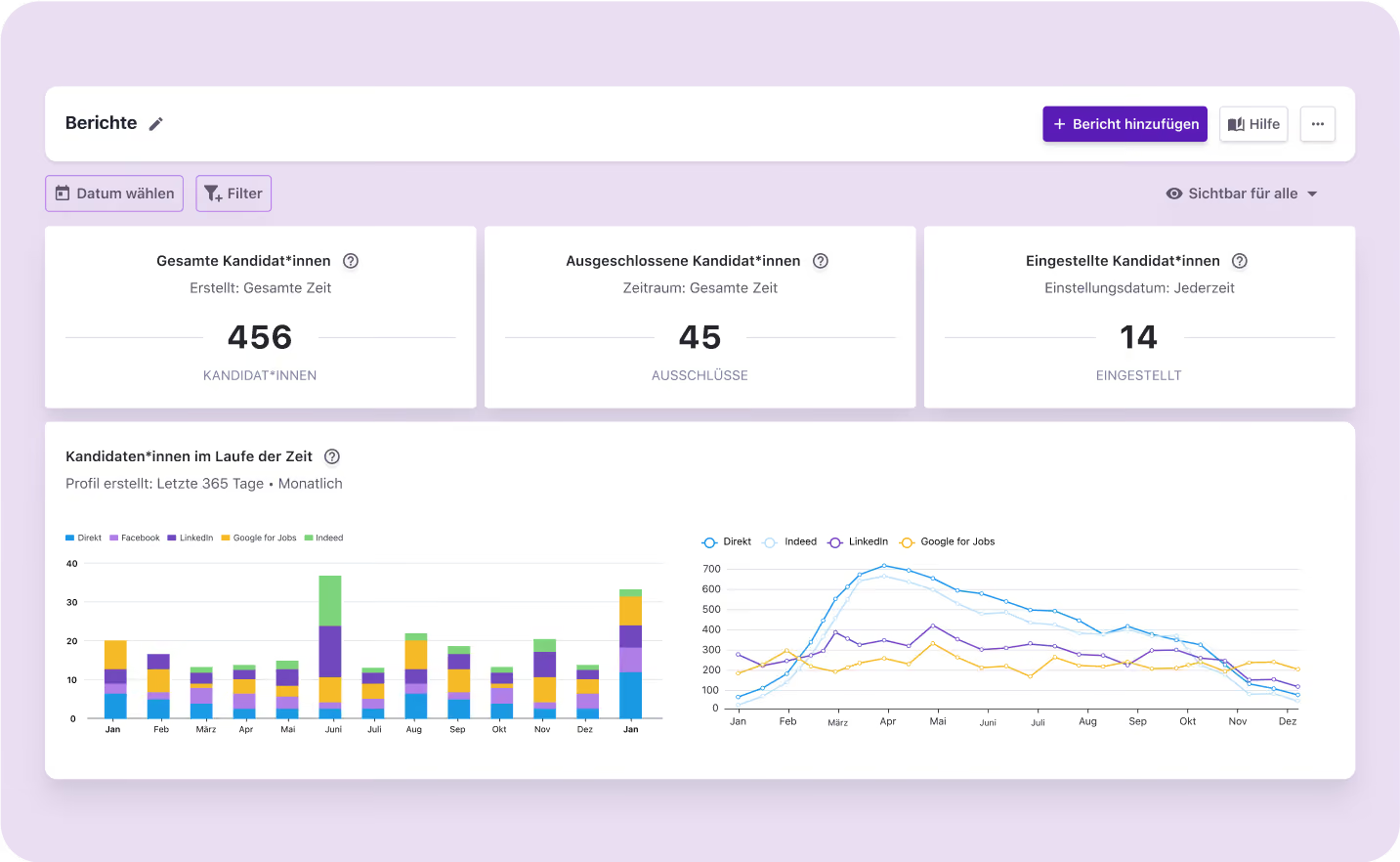
Tellent Recruitee is a great pick for SMBs looking for a collaborative and user-friendly ATS. We had a great experience navigating the platform: it has a nice UI and a Kanban-like recruiting pipeline where we can customize every stage of the process and move candidates by dragging and dropping the cards. The people behind Tellent Recruitee also did a great job in developing the overdue candidate reminder tool: when a candidate sits for too long in your pipeline without getting any updates, it will send a friendly reminder to you.
Another thing we like about Tellent Recruitee is its collaboration capability. The platform says: you can have as many users as you need in Tellent Recruitee, no matter which plans you have opted for, and it doesn’t cost you an extra penny, and it means it. This, combined with the permission adjustment feature, makes it easier to deliver collaborative and unbiased hiring.
That said, some trade-offs were also spotted. First was the absence of built-in tools for skill assessments, onboarding, video interviewing, and e-signatures. While small teams can rely on integrations to fill these gaps, this approach may increase operational complexity. We also noticed that the reporting feature sometimes fails to retrieve data accurately, which can be frustrating for SMBs that rely on clear, real-time hiring metrics to make decisions. Additionally, Tellent Recruitee has increased its pricing recently, though to be fair, those increases have come alongside meaningful feature updates.
Semrush, Mark and Spencer, Transcom, Taco Bell, Toyota, Asus, Livestorm, Rakuten.
Tellent Recruitee offers three annual plans with an 18-day free trial.
- Start costs €270/month for 5 job slots and basic recruitment tools.
- Advance at €343/month, provides unlimited job slots, workflow automation, and permission settings.
- Optimize priced at €1,374/month, includes API access, dedicated customer success, and guided onboarding.
Tellent Recruitee’s latest updates bring in smarter automation with Automated Actions, pre-onboarding through Journeys, and even AgencyHub to simplify working with external recruiters. We also found the new WhatsApp Hiring integration to be a nice way of cutting down on no-shows while keeping candidates engaged. On the HR side, updates like DATEV payroll integration, flexible time tracking, and customizable employee data views help extend Tellent Recruitee’s value past recruiting into everyday workforce management. All of this shows that while Tellent Recruitee remains simple enough for SMBs, it’s also evolving into a platform that can grow with them.
Best For
Tellent Recruitee is a good bet for small and medium-sized businesses looking for an easy-to-use ATS with robust features for collaborative hiring.

I use Tellent Recruitee every day, the whole day! It's such a great system to track candidates and it's all in one place. I can contact candidates and it's all recorded. Each candidate has a profile, I can upload documents (offer letters, employment applications, etc.) I can text candidates using another system called JustCall, everything in one place! I can create a website through Tellent Recruitee! I can directly share open jobs via Rectuitee on platforms such as Facebook, LinkedIn, etc.

I like how easy it is to understand and use the system. I love the live support they use, they are fast to get back to you. I like how modern the UI is and how updated it is in terms of the latest features and functionalities.
Great question, we have been using Tellent Recruitee for almost a year now, and it has been the best decision ever. We get to track candidates and offer a smooth hiring process. Before having Tellent Recruitee in the house, we were using spreadsheets, which was painful and extremely time-consuming, we couldn't track well without many integrations and automation, and the manual efforts were not productive. This ATS is the best!
Something I hope they can work out better is to get the text messages incorporated faster. They claim to have been working on it for a while, but we don’t really know until it is rolled out. I wish they had more integrations as Paylocity, I believe they are expanding their list. The last thing, I wish they give you more options to change the theme color of the screen and other customization options.
Yes, pricing-wise. Modern and easy to use. I have used other ATSs that are not that easy to use. The integrations at Tellent Recruitee are great!
They should think about how this ATS offers everything! They are very open to feedback and willing to work on the ideas you might have. This ATS is complete.
Tellent Recruitee has helped the company tremendously, it has helped me as a Recruiter and also the Managers. Everyone I know who has used this ATS loves it!
Recruiting, onboarding, background check. Medium to large-sized organizations can maximize their use cases.
It wouldn't work for a small company that is not hiring much. This system is only good for a company that is looking to hire constantly, with respect to the costs and advanced functionalities it has.

Trakstar Hire
Trakstar Hire outperforms the typical ATS with features like unlimited job posting, resume duplication detection, and advanced customization capabilities. Trakstar Hire is a favorite pick for SMBs as its undisclosed pricing is negotiable based on customers’ annual number of job openings.
PROS
- Recruitment workflow is highly customizable.
- Native, in-platform collaboration hiring features allow users to delegate tasks, collect evaluations, and schedule interviews without third-party tool integrations.
- Users can create unlimited job posts and add as many hiring managers as they need without added cost.
- Offer management is built into the product, so users can create, send, and store offer letters directly through the platform. They even do e-signatures!
- Trakstar Hire’s recruitment workflows are highly customizable. You can edit them as needed to reflect your company’s hiring process.
- You can post as many jobs as needed with Trakstar Hire without any limitation.
- Trakstar Hire has offer management tools built-in. Users can create offer letters and collect e-signatures within Trakstar Hire without needing to integrate it with third-party tools.
CONS
- Limited integration options with third-party HRIS and payroll solutions.
- No mobile apps.
- As Trakstar Hire offers only one plan with all features included, some businesses looking for a basic ATS may need more time to find it.
- No free trial or free plans. Trakstar’s pricing is all-or-one and undisclosed.
- Trakstar Hire has limited integration options with third-party HRIS and payroll solutions.
- Several users have complained about being unable to sort candidates and search results in an order other than displayed.
- Trakstar Hire isn’t a scalable platform; they have a single plan, all features included, which means customers may end up paying for features that they don’t need.
- Trakstar doesn’t publically list their pricing nor allows visitors to create trial accounts directly from the website, which is unusual for a software solution aimed at mid-market companies.

Trakstar Hire ATS (formerly Recruiterbox) is ideal for midsize companies. Still, the platform does work out deals for small businesses as they have room for negotiation based on how many job openings they have annually.
Rather than offering a feature-light product, Trakstar Hire ATS carries nearly everything you can ask for in a modern application tracking system: resume management, candidate sourcing, interview scheduling, offer management, collaborative hiring, reports, and careers site management.
Does the company overdo it? Based on our experience with Trakstar, the answer is yes and no.
It’s challenging to master many things simultaneously, but Trakstar Hire makes learning their tool manageable by presenting users with a well-made set of core products. We’ll start with job posting.
When a job is added to the platform, it is automatically distributed to LinkedIn, Facebook, Google, careers pages, job boards, and search engines. There is no limit to the number of jobs you can post, which is helpful for teams who hire frequently.
We love a smooth, customized workflow, and Trakstar Hire delivers in the “tailored experience” department. Users can customize literally every step of the way, making their hiring experience stand out against the rest but also fold into the best operational flow for the business.
We are also big fans of products with built-in features like offer management. No plug-in is necessary! Creating, sending, and storing offer letters all in one place makes sense.
There’s no such thing as a perfect tool, and we’d be remiss if we didn’t point out some aspects of the platform that cause us concern.
A free trial was available when they were still Recruiterbox in 2021. In 2023, there’s no more free trial, and the pricing is now undisclosed.
We’ve already touched on the lack of integrations, but it’s worth restating. Though it’s a very capable ATS, being unable to integrate with standard HR tools is a significant drawback.
Makita, Couchsurfing, Lonely Planet, Untappd, Quality Ironworks.
Trakstar Hire has one plan that includes all of its features without any limits. The pricing is custom depending on headcount.
Best For
Trakstar Hire is a powerful ATS for SMBs assessing one hundred or more candidates annually.

I used Trakstar regularly as part of my day-to-day HR and recruiting work. On a weekly basis, I reviewed incoming applications, moved candidates through the hiring stages, and coordinated with hiring managers.
I used the system to post and manage job openings, track candidates, and collect interview feedback. On a monthly basis, I relied on reporting and pipeline visibility to monitor hiring progress. It was a key tool for keeping the process organized and consistent.
- I like that Trakstar Hire kept the entire recruiting process in one place, which made it easier to stay organized and avoid losing track of candidates.
- The platform made collaboration with hiring managers smoother.
- I appreciated how straightforward it was to move candidates through different stages.
- It helped keep candidate communication centralized, which saved time and reduced back-and-forth emails.
Trakstar was already in place when I joined my organization, as it was the system being used to manage recruiting at the time. It was implemented to bring structure and consistency to the hiring process and reduce reliance on manual tracking and email communication.
The platform allowed the team to manage job postings, applicants, interviews, and feedback in one centralized location, which made collaboration much easier. I used it regularly for about two years as part of my responsibilities. It became a core tool in our recruiting workflow and something we relied on consistently throughout the hiring process.
- Trakstar Hire had a learning curve for new users, particularly hiring managers who were not familiar with applicant tracking systems.
- The reporting options could have been more customizable.
- Some areas felt dated and required too many clicks when moving candidates through the pipeline.
Compared to other systems I have used, Trakstar stood out for its solid core recruiting functionality and straightforward workflows, even if it was not as widely recognized as some larger platforms. Since it was less familiar to some hiring managers, there was a learning curve for certain leaders.
- Make sure the system supports the full hiring process in one place to avoid manual work or disconnected tools.
- The platform should be intuitive for recruiters and hiring managers, especially those who use it most often.
- Strong vendor support and implementation guidance can have a significant impact on long-term success.
Over time, the platform became more streamlined and user friendly, with improvements that made collaboration and candidate tracking easier. Enhancements to scheduling and pipeline visibility helped reduce manual effort.
Trakstar Hire is well suited for small to mid-sized organizations that need a straightforward, centralized system to manage the hiring process from start to finish.
Trakstar Hire is not well suited for large organizations, especially those already accustomed to enterprise platforms such as Oracle or Workday.

Recruit CRM
Recruit CRM is popular among employment agencies and SMBs because it combines ATS and CRM features in one platform, offers a generous free trial, and has transparent pricing.
PROS
- Combines ATS and recruiting CRM in one platform.
- Affordable and transparent pricing. Free trial available.
- Resume parser provides unlimited resume parsing and supports 28 languages.
- Support available for all users includes live chat, training sessions, and dedicated CMS.
- Regular product feature updates.
- No extra fees required for basic data migration that includes importing Excel/CSV files with candidates & clients. During the implementation process of this software, the customer service personnel will help transfer your data for free.
- Great customer service. Their average response time is under two minutes.
- Powerful Linkedin Integration & Executive/Recruitment Report PDF Generator to save time
- Tons of resources made available to users including blogs and articles that give you all the information you need to know about how the software works, job description templates to help you get acquainted with all the possible job openings you will be looking to close, and a glossary that gives you the A-Z of recruitment practices.
CONS
- Limited to two candidate matches and 1 email sequence in the Pro plan.
- Can’t search logged text under Call Notes.
- Not the best fit for corporate recruitment.
- Lacks employee referral and onboarding features.
- Limited native integrations. Recruit CRM only integrates natively with LinkedIn, Zapier, Logic Melon, some email apps, and Google and Outlook calendars. If you want to run background checks, for example, using Checkr or other background verification platforms, you won’t be able to do that unless you use Zapier’s API extension.

In our testing, Recruit CRM impressed us with its ability to meet the needs of small businesses, particularly recruiting agencies that require handling both client and candidate pipelines.
Small teams who spend hours daily on data entry will appreciate the AI resume parser that Recruit CRM offers. It can parse up to 100 files at a time and works with resumes from multiple sources in 28 different languages.
Recruit CRM is easier to use than many other ATSs we’ve tried. In addition to the mobile apps (which we tested and loved), the Kanban view offers a visual way to manage candidate pipelines. Automation enthusiasts will love the drag-and-drop functionality and automated email triggers at various stages. As a bonus, the in-app instructions are clear-cut and make navigation easier.
Small or medium-sized agencies could hardly go wrong with this vendor’s CRM tools. You can manage client relationships, schedule meetings and emails, and track interactions, all from within the platform. Plus, you get unlimited access to training materials, the live chat takes two minutes on average to reply, and there’s a roadmap page where you can request new features.
Unfortunately, Recruit CRM’s Pro plan limits candidate matches to two and email sequences to one—a letdown, particularly for those with multiple placements to fill at a time but can’t afford higher-tier plans. Also, remember that the search function can only search for keywords in candidate resumes and profile data fields, but not in the user’s logged call notes.
Lastly, Recruit CRM is not intended to serve corporate users, so it lacks certain features that in-house TA teams usually prioritize in their ATS, such as referral and onboarding.
1,200+ companies, including Randstad, Michael Page, ManpowerGroup, Kelly Services, and PageGroup.
Recruit CRM offers three pricing tiers:
- Pro Plan: $85 per user/month when billed annually, $100 per user/month when billed monthly.
- Business Plan: $125 per user/month when billed annually, $150 per user/month when billed monthly.
- Enterprise Plan: $165 per user/month, billed annually only.
Best For
Recruit CRM is best suited for small to midsize recruiting, staffing, executive search, and headhunting agencies that prioritize automation and ease of use.

I use Recruit CRM to recruit employees from different locations worldwide. The tool helps me create assignments and tasks for employees and generate meeting notes before online meetings. I also use it to visualize employee performance data and share it with the higher management team.
I like the integration with calendar and online meeting tools like Zoom. The pricing is affordable and does not negatively impact the ROI of any business. The customer support team is responsive to technical questions.
Managing, tracking, and recording employees working remotely around the globe was a significant challenge for our company. We faced difficulties in understanding employee needs and improving human resources. Emailing one employee at a time and CCing others was cumbersome. Recruit CRM offered a solution by allowing us to manage employees from a single dashboard and providing robust communication features for emailing employees directly from the tool. I have used Recruit CRM for three years, which has helped me gain more experience as an HR business partner.
The user interface requires significant improvement. The rich text editor for composing emails is unresponsive. The email signature maker offers limited customization options.
Recruit CRM provides more modules at the same pricing level and has a support team that responds promptly to technical questions.
Consider the size of the organization and the pricing of the tool. Also, evaluate the technical knowledge required to set up and use the tool effectively.
There haven't been many changes to the Recruit CRM platform yet.
Recruit CRM is suitable for human resource managers and talent acquisition professionals from medium to large-sized businesses.
Recruit CRM may not be suitable for startups and other smaller businesses that do not require a lot of hiring.

BambooHR
BambooHR is among the top ATS options for SMBs, thanks to its ease of use and full-stack features built-in. The platform also offers flexible plans, which means businesses can benefit from having custom offerings based on their needs.
PROS
- Flexible and tailored pricing, allowing you to choose and scale up features based on your specific needs.
- Free 7-day trials are offered, providing an opportunity to explore and evaluate the ATS functionalities before making a financial commitment.
- Well-performing mobile app, which facilitates application review, communication, and collaboration features on the go.
- User-friendly interface and intuitive design.
- Flexible packaging and custom pricing is the way they roll. You can pick out one or two packages and pick other modules as add-ons based on your needs.
- Very simple and straightforward tool, easy to use.
CONS
- Payroll capabilities are limited to U.S.-based employees, which may be a drawback for companies with an international workforce.
- Customer support is available only during U.S. business hours, potentially causing delays in resolving urgent inquiries for users in different time zones.
- Modules like time tracking, performance management, and surveys are offered as add-ons, requiring additional investment to access these functionalities.
- Payroll is only available for US-based employees
- Customer support is only offered during US business hours.
- Some modules like time tracking, performance management, and surveys are only available as add-ons.
Having looked at dozens of SMB-oriented ATS platforms, we find it impressive that BambooHR packs most of the essential recruiting features into a modestly priced HRIS package.

First, let’s discuss the ATS’s customization capability. During our testing, we appreciated how BambooHR made these features accessible without overwhelming the user—everything felt simple, which is a great strength for small businesses with limited recruiting experience.
We also found the candidate application organization process intuitive. It was fast and easy to track candidates through every stage of the hiring process, from application to final e-signature. Plus, BambooHR allowed us to create new hire packets, which provide essential details on what new hires can expect during their first days—a helpful tool that makes onboarding smoother.
BambooHR’s mobile app for hiring is equally loveable. Users we spoke to enjoyed the flexibility it provided. Through the app, hiring managers could post jobs, review resumes, communicate with candidates, and coordinate with other team members while on the move. Just to be sure, we also tested these mobile capabilities ourselves, and phew! The experience was positive. This ability to carry out hiring activities from a smartphone is a real differentiator—especially when compared to tools like JazzHR, which, although feature-rich, lacks the same level of mobile optimization.
BambooHR also scores points with its flexible pricing options. The ATS, though custom, is modestly priced and allows you to choose and scale up features based on your specific needs. A free 7-day trial is also available upon request, so anyone interested can explore and evaluate the platform before committing financially.
When we compared BambooHR to other applicant tracking systems catering to SMBs, such as Trackstar Hire and Zoho Recruit, we found BambooHR’s user interface to be particularly well-designed and easy to use. Additionally, the collaboration features within BambooHR, like the ability to comment on candidate profiles and track team progress, were well-executed and on par with the best that tools like Recruitee offer.
However, it’s worth mentioning that BambooHR doesn’t offer its ATS as a standalone tool. Instead, it’s mixed with time off, benefits, and employee experience, which can be an overkill for those looking for just applicant tracking software.
It’s also quite a letdown to find out that though BambooHR’s customer support is helpful, it’s only available during U.S. business hours, which could lead to delays if you’re in other time zones.
33,000+ companies, including Quora, Universal Group, Reddit, and Asana.
BambooHR pricing is custom. For companies with more than 25 employees, pricing is based on a per-employee, per-month model, while those with 25 or fewer pay a flat monthly rate. There are no annual contracts, and volume discounts are automatically applied as employee counts increase.
Best For
BambooHR is an excellent choice for small businesses, ideally U.S.-based and rapidly growing, that are looking for a feature-rich HRIS with ATS tools built in, all at a reasonable price.

We use BambooHR a bit unconventionally. Although it offers broader HR capabilities, we use it primarily as an ATS. It has significantly improved our recruiting processes. We can link job postings to LinkedIn and customize application questions to simplify sourcing.
Our hiring managers have admin access, allowing them to review and select qualified candidates. We’ve had a positive experience with BambooHR overall and are considering expanding its use to payroll.
- The price is unbeatable for what you get; I haven’t found another ATS like it.
- It was very easy to get started, and the platform is user-friendly.
- Their support team has been helpful when needed.
We bought BambooHR primarily to use as an ATS. We reviewed many ATS vendors, but BambooHR offered a strong product, especially for the price. It solved our talent acquisition challenges and made collaborating with hiring managers much easier.
Our hiring managers can review and select candidates directly within BambooHR. The key benefit for us is that it has streamlined our recruiting efforts. I have been using BambooHR for less than one year.
- The ATS functionality is quite simple, though sufficient for our current needs.
- The reporting and analytics features could be more comprehensive.
- If we shift to high-volume recruiting, BambooHR may not meet our requirements.
My experience with ATS platforms is limited to two others, and BambooHR is my favorite of the three. One feature I really appreciate—and I know our candidates do too—is that applicants don’t need to create an account to submit an application.
One important factor is understanding what you plan to use the tool for. If you’re using it for payroll and other HR functions, it's worth checking whether BambooHR supports international payments.
We would need to research this further before using it for payroll. If you're using it primarily as an ATS, consider how many roles you need to fill and whether you recruit at high volume.
We started using BambooHR in Q2 of 2025, so it's still fairly new to me. I haven’t seen any significant changes or updates since we began using it.
I think BambooHR could work well for many organizations, but it's likely best suited for small or medium-sized businesses.
From an ATS perspective, companies that conduct high-volume recruiting may find that BambooHR doesn't fully meet their needs.

Homebase
We found that Homebase works best when speed and ease of use matter more than flexibility. It’s a practical ATS that helps small businesses move from job post to hire without getting bogged down in the process.
PROS
- AI-powered screener with industry-specific and custom questions
- Deal-breaker filters to eliminate unqualified applicants early
- Real-time activity feed tracking every applicant and hiring assistant action
- Built-in distribution to all leading job boards
- All-in-one platform designed for SMBs, no additional software needed
- Quick setup with no HR support required
- Mobile-first application experience to boost applicant volume
- Low starting cost for budget-conscious teams
- Separate dashboards for managers and employees
- Real-time communication features allow for schedule changes on the move
- Requesting and approving paid time off is easy
- Great scheduling templates help managers streamline work
CONS
- The starter plan restricts users to one active job post
- Not suitable if you plan to hire internationally
- Reporting tools felt fairly limited compared to more advanced systems
- Limited third-party integration support
- Additional features are somewhat expensive

The first thing we noticed about Homebase was how quickly it gets out of your way. The Hiring Assistant writes the job post for you and publishes it to top job boards in one click. For small teams, being able to go from zero to live applicants without touching a single setting is a meaningful time saver.
The application experience is clearly designed with mobile users in mind. In our testing, candidates could apply quickly without needing a resume or a desktop, and the text-to-apply option made it even easier to capture interest on the spot. This resulted in a steady flow of applicants, particularly for hourly roles where convenience tends to matter more than polish.
Once candidates start coming in, the AI Hiring Assistant takes over the screening process through live conversational exchanges with each applicant. Rather than leaving hiring managers to sift through raw applications, it builds a complete candidate profile from those conversations and surfaces the most relevant experience in an easy-to-scan format. The "Top Match" label gives owners a clear starting point for deciding whom to prioritize.
Interview scheduling is one of the more tedious parts of hiring, and Homebase handles it well. With auto-scheduling enabled, candidates select or propose times based on the hiring manager's availability, cutting out the back-and-forth that typically drags this stage out.
We also appreciate how everything sits within the same system. Job posting, candidate tracking, background checks, and onboarding all happen in one place, which makes the overall process feel more contained and easier to manage day to day.
There are, however, a few limitations that became more noticeable over time. The Starter plan is limited to a single active job post, and we also found some of the workflows a bit rigid—for example, requiring duplicate job posts rather than simply reopening them.
As we spent more time with the platform, it became clear that Homebase is built specifically for SMB hourly hiring. That focus is a strength for straightforward hiring, but it means the platform won’t be much of help for those looking for enterprise-grade customization or deep analytics.
Fuzzy Goat Yarn Shop, The Blind Goat & Xin Chao, and Arthritis and Osteoporosis.
Homebase offers two main pricing tiers for hiring tools per location:
- Starter Plan ($30/month): Includes one job post, 20 AI screeners, and 1-click job board posting.
- Unlimited Plan ($199/month or $99/month annually): Offers unlimited job posts and screeners, five monthly background checks, and full access to scheduling, screening, and onboarding.
The vendor is also offering a promotion from Sep 15, 2026 to Jan 20, 2027 where new custom gets 6 free months of the All-in-One plan.
Best For
U.S.-based small businesses hiring hourly or frontline workers that need a simple, mobile-friendly ATS.

We use Homebase on a daily basis. We use it to schedule our staff. We also use the time tracker to track staff working hours. We use the time clock, which is an app that works on mobile and desktop devices. Additionally, we use the more traditional timesheet module. Both of these link into the payroll module, allowing us to calculate salaries through the system.

I really love the time-clock app, which makes time recording more efficient and reduces time theft. I love that Homebase is highly expandable—we started with just the rota and expanded to include the time clock, timesheets, and payroll. I think it is well-priced, and you get a lot of value for your money.
We were using an Excel-based rota to manage staff hours, but as staff numbers increased, it became cumbersome. The rota had macros that were proving unreliable on different platforms. We wanted an online system to manage our rotas. The key benefits Homebase provided were a lot of automation, including staff shift-swapping. I have used Homebase on and off for about five years.
The geolocation on the time clock can be glitchy at times. It's only suitable for US employees, as you can only pay in dollars, and customer service is US-centric. The mobile app seems to be somewhat limited on iOS.
I think Homebase offers more expandability compared to its competitors. It is also reasonably priced in comparison. The pricing model suited us better than others because we have just a few locations with quite a few staff, and Homebase's pricing is driven by the number of locations rather than the number of employees.
Since it's primarily a scheduling tool, it needs to have a high-quality rota with plenty of automation and shift-swapping as a minimum. Rotas, timesheets, and payroll are closely linked workflows, so it's best to look for software that includes all three areas of functionality to maximize efficiency.
Homebase has gradually expanded its service offerings, allowing users to treat it as a one-stop shop for HR functionality. While this can be more expensive than using separate tools, the convenience of available add-ons is beneficial for those who want an all-in-one HR solution.
Homebase is ideal for US-based organizations with a tech-savvy workforce.
Due to the pricing model based on locations, Homebase might not suit companies with many locations but only a few staff at each location.
Keka
Keka’s ATS offers a well-rounded mix of recruiting tools, automation options, and integration potential. We were drawn to its flexibility, as SMBs can use it as a stand-alone system or connect it with Keka’s HR, payroll, and performance modules for a single-platform experience. Its tiered pricing makes it accessible for smaller teams while offering advanced automation, integrations, and customization for more complex hiring needs.
PROS
- Customizable hiring stages and requisition workflows for each department.
- AI-assisted job description creation and built-in resume parsing.
- Candidate self-scheduling and structured interview scorecards.
- Duplicate application detection with configurable reapplication rules.
- Advanced tier adds workflow automation, CV-JD match scoring, and integrations with job boards, assessments, and video interviews.
- Federal and state tax filing is included at all tiers.
- Flexible pay schedules with direct deposit support.
- Overtime and leave policy automation to match local labor laws.
- Benefits, loans, and expense tracking in one place.
- Built-in dashboards and reports to monitor payroll trends.
- Accounting integrations for streamlined finance workflows.
CONS
- No self-service free trial; demo with sales is required first.
- Implementation fee applies for setup and (if needed) HR/payroll integration.
- Platform was slow to load during our demo.
- “Free Trial” access is gated behind a sales demo and disclosed only after signup.
- Implementation fees for setup, tax configuration, and data migration.
- Advanced tools (custom reports, asset tracking, engagement surveys) only available in higher tiers.
- Multi-entity payroll and API access require add-on fees.
- Slow load times in the demo raise usability concerns about payroll deadlines.
Keka ATS (named HIRO) gives SMB recruiters a full set of tools to manage hiring from requisition to offer, with the flexibility to adapt workflows to different roles and departments. In our demo, the left-hand navigation made it easy to access job postings, candidate lists, and reports without losing track of where we were in the process.

We started with job and requisition management, where hiring managers can create openings, define custom pipeline stages, and tailor them per department or role. Internal and social referral channels are built in, and an AI assistant can generate job descriptions from scratch. The system also supports internal job boards for promoting roles to current employees.
Candidate management is one of Keka ATS’s stronger areas. Recruiters can parse resumes, tag candidates, and assign them to talent pools for future openings. The demo showed three types of interview scheduling: online, face-to-face, and self-scheduling, the last of which lets candidates pick from pre-set time slots—something that reduces back-and-forth considerably. Each interview can be linked to scorecards, which help interviewers rate candidates against consistent criteria, minimizing bias.
Interestingly, there’s a duplicate detection feature that flags candidates who reapply too soon. Recruiters can set the “cool-down” period and choose whether to merge or overwrite old application data. In the Advanced plan, we also saw integrations with major job boards (LinkedIn, Indeed, Monster), assessment platforms, and video interview tools, plus CV-JD match scoring to quickly identify the best fits.
Offer management and preboarding are built in: recruiters can send offer letters, run them through an approval workflow, and collect candidate data through a dedicated portal. That data can then flow into Keka’s HR module if purchased, but the ATS itself is fully functional as a stand-alone tool.
However, from our experience, the buying and onboarding process felt more rigid than with many other ATS platforms we’ve tested. In fact, we aren’t happy that the “Free Trial” option stated on Keka’s site is just a tease, as once you sign up, you’re booked in for a sales demo before you can actually touch the product.
We’d recommend you factor in the implementation fee for setup and any HR/payroll integration, given that it could bump up the total cost more than you might expect at first glance. And the slow page load times we saw during our demo, although they could be just a one-off event due to a bad internet connection, may be something you’d want to keep in mind when exploring the platform yourself, especially if you’re a busy recruiting team handling dozens of candidates a day.
10,000+ companies, including eBay, Randstad, and ONEPLUS.
Keka offers two plans, Pro ($50/month/recruiter) and Advanced ($75/month/recruiter), both with free trials after sales demos.
Best For
Small to mid-sized businesses seeking a flexible ATS that can operate independently or integrate with Keka’s HR/payroll products as they grow.

Manatal
Manatal is an affordable ATS with a 14-day free trial. Its AI features are handy and drag-and-drop functionality also makes organizing candidate pipelines easy.
PROS
- Affordable ATS with a 14-day free trial.
- User-friendly interface with drag-and-drop pipelines.
- Good AI features for job description generation and profile recommendations.
- Free data migration from existing hiring software with automatic duplicate detection.
- Suitable for both in-house TAs and recruiting agencies.
- Supports multiple languages.
- Manatal is quite affordable and offers a 15-day free trial for users to test it out before making commitments.
- Manatal is fairly easy to use. It features drag-and-drop enabled pipelines for candidate organization.
- Manatal’s AI-based recommendations feature can save hiring managers quite a bit of time. It’s able to scan job descriptions then search a users talent pool and bring up candidates most suited for the job.
CONS
- AI can only generate English job descriptions, limited to 200 per month.
- Core product available only in English and Spanish.
- No free plans available.
- Limited native integrations. API and Zapier integrations for top-tier plans only.
- Boolean Search and Advanced Search cannot be used simultaneously.
- The AI recommendations feature works best with resumes that are in English, and doesn’t work as accurately with other languages according to several users’ feedback. Several users have also complained about Manatal’s interface only being available in English and that career pages cannot be published in languages other than English and Spanish.
- Manatal doesn’t offer a free plan. We mention this as a con as several SMB-geared ATSs do offer a free-forever verison, and that puts Manatal slightly behind competition.
- Manatal doesn’t offer prebuilt integration modules. They do have an open API that allows users to plug in third-party products and custom tools, but that required a bit more time and technical knowledge to accomplish. It’s also worth mentioning that only Custom plan customers can access Manatal’s API and Zapier integration. Customers on the Professional and Enterprise plan cannot.
- Users can search for candidates via Boolean Search or Advanced Search, but cannot combine the two search methods together. E.g users cannot use the Boolean search operators (AND, OR and NOT) within Manatal’s Advanced Search tab.

Manatal is a budget-friendly ATS solution that caters specifically to SMBs without compromising essential features. It even has a free trial without requiring credit card info.
Manatal’s AI tool is a real asset. It can generate English job descriptions and sift through your existing candidate database to surface individuals it finds most suitable for the role. The results are pretty awesome and available almost instantly. Its usefulness was reduced when we asked the AI to suggest non-English-speaking candidates, though.
Manatal has a user-friendly interface and native drag-and-drop-enabled pipelines, which are very easy to use. Plus, being mobile-optimized means there’s no need to download any apps from users who need to access Manatal on the go.
We also appreciate how transparent Manatal's pricing is. The platform has a scalable “custom” plan in addition to three lower-tier plans. On its website, it breaks down what’s included in each plan and how much it costs. With prices starting at $15 per user per month, it’s safe to say this ATS is affordable for most SMBs. For those having a hard time with their existing ATS and looking for a switch, Manatal’s offer of free data migration is quite compelling.
However, as mentioned earlier, Manatal’s AI tool works best in English only and only allows for 200 generations per month. Despite having a fairly good pricing structure, Manatal doesn’t offer a free plan like several others in this space. We should also note that its API and Zapier integrations are limited to top-tier plans, while the pre-built integration list is limited.
10,000+ companies, including Unilever, Coca-Cola, Panasonic, Ogilvy, and Toyota.
Manatal has four plans:
- Professional ($15 per user per month)
- Enterprise ($35 per user per month)
- Enterprise Plus ($55 per user per month)
- Custom plans (available on demand)
A 14-day free trial is available, no credit card info required.
Best For
For startups and SMBs with limited budgets who are seeking an easy-to-use ATS with AI features, Manatal is a top choice.

Hirex
Hirex earned its spot by delivering a practical combination of AI-driven candidate scoring and highly flexible hiring pipelines, which help hiring managers prioritize candidates faster while adapting workflows to their needs. This balance of automation and customization makes it especially effective for small businesses that want structure without rigidity.
PROS
- AI resume parsing and scoring help identify top candidates in a matter of seconds.
- Flexible pipelines allow teams to customize hiring with multiple stages (e.g., screening, technical assessments, case studies, and multiple interviews).
- Collaborative candidate profiles streamline communication between TAs and hiring managers.
- Transparent pricing with 30-day free trial available.
- AI resume parsing and scoring help identify top candidates in a matter of seconds.
- Flexible pipelines allow teams to customize hiring with multiple stages (e.g., screening, technical assessments, case studies, and multiple interviews).
- Collaborative candidate profiles streamline communication between TAs and hiring managers.
- Transparent pricing with 30-day free trial available.
CONS
- Expansion into the U.S. and global markets is ongoing, which could currently limit support and scaling capabilities.
- AI is helpful but still basic, mainly limited to scoring and parsing as of this writing.
- Limited ecosystem compared to competitors like Greenhouse or Lever.
- Pricing is relatively higher than some competitors like Manatal and AvaHR.
- Expansion into the U.S. and global markets is ongoing, which could currently limit support and scaling capabilities.
- AI is helpful but still basic, mainly limited to scoring and parsing as of this writing.
- Limited ecosystem compared to competitors like Greenhouse or Lever.
- Pricing is relatively higher than some competitors like Manatal and AvaHR.
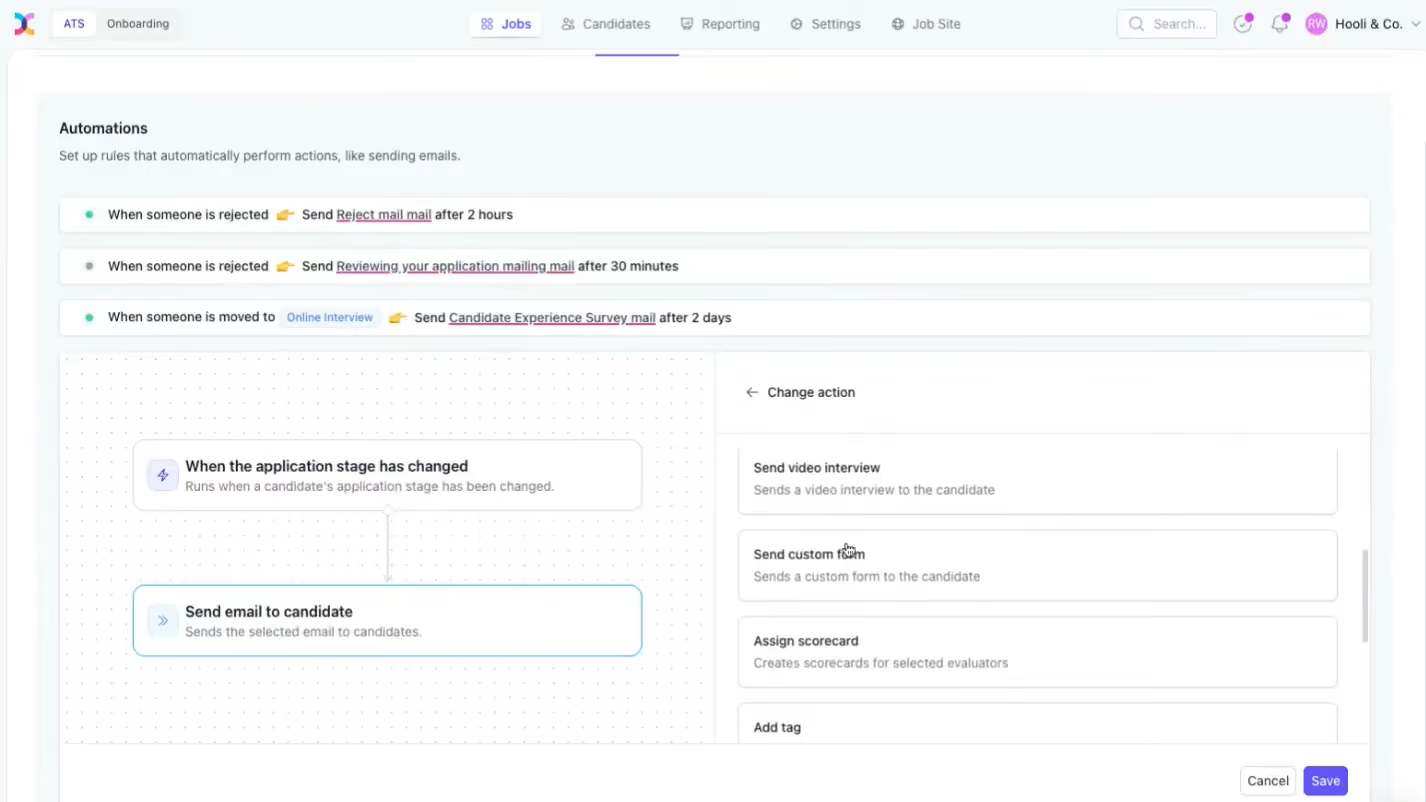
Hirex is best understood as a “step-up ATS” for small businesses. We found it to be ideal for teams transitioning away from spreadsheets, email-based hiring, or overly basic tools, though it doesn’t yet operate at the same level as enterprise systems.
As we explored the built-in AI, we noticed that while it isn’t the most advanced we’ve seen, it is highly practical for streamlining candidate screening and organization. Once candidates apply, the system parses resumes and automatically scores them based on job-specific criteria pulled from the job description. In our testing, we spot-checked profiles at both the top and bottom of the rankings, and we found the results to be accurate. Of course, we believe human oversight remains essential, but this level of automation can save hiring managers a significant amount of time.
We also appreciated how flexible the hiring pipeline is during our evaluations. It was easy for us to customize, and the integrations allow teams to send assessments and video interviews directly from the platform while receiving results automatically in the candidate profile. This combination of flexibility and centralization proved to be especially valuable for small businesses, where hiring workflows are still evolving and often rely on multiple tools for different stages of the process.
The candidate profile page served us well as a shared workspace. We were able to review resumes, leave comments, track communication, and complete scorecards all in one place. In practice, this made collaboration between recruiters and hiring managers much smoother, even without a formal hiring structure.
That said, we recognized that Hirex is not trying to compete head-on with enterprise ATS platforms, which became clear to us in a few areas. First, we found the AI capabilities to still be relatively basic. While resume parsing and scoring are helpful, we did not observe more advanced functionality. According to the vendor, lots of promising features (LinkedIn sourcing agent, AI interview note taker, natural language filters, AI phone interviews), are on the roadmap.
Second, we noted that the integration ecosystem is still developing. Although Hirex offers integrations across key areas—assessment, HRIS, job board, sourcing, and video interviewing—the selection (30+) is simply not as comprehensive as what is available from industry leaders such as Greenhouse (400+), Pinpoint (100+), and Workable (270+). As hiring needs grow more complex, we believe this could become a limitation.
Lastly, Hirex's current focus is Turkey, and while it's managed to hold its own against major competitors in the tough European market, its footprint is still regional. The immediate consideration is their very recent, early-stage expansion into the U.S. and UK, which suggests their global scalability and comprehensive support are still developing. Nevertheless, their impressive growth over the last year inspires our confidence in their future development.
Hirex serves around 40 companies to date.
$250/month; a 30-day trial is available.
Best For
Small businesses that want structure, automation, and collaboration without overcomplicating hiring.
Why You Should Trust Us
The contributors to this buyer guide represent decades of experience and perspective. We called on Stefanie Sher (Director of Talent Acquisition, Replicated), Tracie Marie (Founder, Hire Incentive), Zachary Larson (People Operations leader with 10+ years experience), Phil Strazzulla (SSR Founder), Huda Idris (SSR Software Advisor), and SSR HR Tech Researcher and Editor Anh Nguyen to help you find the right tool for your team.
Benefits of ATS for Small Businesses
Benefits of using an ATS for small businesses include saving time, improving the quality of hires, reducing costs, becoming more data-driven in recruitment, facilitating collaborative hiring, and building a talent pool.
- Save time: Recent applicant tracking system statistics show that recruiters can reduce time-to-hire by up to 20% when using an ATS solution. Additionally, 86% of recruiters report that ATS solutions have helped them shorten their time-to-hire, at least to some extent. For SMBs, these numbers mean fewer manual tasks and faster candidate movement through the pipeline, freeing up time for team members who often have to wear multiple hats beyond recruiting.
- Increase the quality of hire: Compared to manual applicant tracking, an ATS tailored to the needs of small businesses can aid tremendously in structured evaluations, reduce bias, and ensure that the most qualified candidates rise to the top. Statistically, 78% of recruiters confirm that an ATS has improved the quality of hire.
- Save money: Small businesses can enjoy $10,000 annual savings using an applicant tracking system. Output from our ATS calculator has shown that a 500-person company can save up to $468,000 from a new ATS.
- Become more data-driven with recruitment: Though the small teams are held to the same legal standard as larger ones, they generally don’t have the same access to legal counsel. A quality ATS will help cross the Ts and dot the Is, allowing your business to focus and grow.
- Forster collaborative hiring: In small businesses, where “wearing many hats” is the norm, an ATS brings structure and transparency to collaborative hiring. It organizes tasks, centralizes candidate information, and clarifies who’s responsible for what, helping teams work together efficiently without letting anything slip through the cracks.
- Build a talent pool: A high-quality talent pool doesn’t create itself. Small business ATSs typically can also function as a recruiting CRM, helping small businesses establish and nurture a repository of skilled workers. By creating and managing ongoing relationships with both passive and active job seekers, a lean team can reduce the effort and expense of filling a new role; they can simply tap into the existing pool rather than starting the search from scratch. Some tools even help with considering internal candidates.
How to Choose the Best ATS for Small Businesses
Small businesses seeking an applicant tracking system might find it helpful and time-saving to start by considering just 3 to 5 vendors recommended by industry experts. Additionally, reviewing user feedback, attending product demos, and trialing the ATS firsthand can provide valuable insights to help narrow down the choices further.
- Look for unbiased insights: Most ATS vendors have websites with plenty of information on how good their product(s) are, but rarely do they highlight gaps, trade-offs, or shortcomings. For this reason, we suggest you make the most of third-party reviews, buyer guides, and independent product breakdowns to gain a balanced view of each ATS’s pros and cons. This broader perspective helps you understand where each tool performs well (and where it may fall short) so you can make the right decision for your team’s realities.
- Learn from other small business ATS users: There’s a tremendous amount of value in the feedback of real product users, particularly those working at startups and small businesses. What are their ATS decision criteria? What are their expectations about hiring software vs. reality? How satisfied are they with the purchased ATS? In each of our small business ATS’s detailed reviews, we include insights directly from HR and recruiting professionals using the tools so that you can learn from their firsthand experiences.
- Talk to 3-5 most potential vendors: If your business is too small to justify sending out a formal ATS request for proposal (RFP), you'll need to vet companies yourself. Take advantage of our recommended tools to shortlist the top 3-5 relevant vendors. Then, schedule and come to their product demos prepared. We’d suggest having a list of applicant tracking system questions specific to your small business needs (whether they offer unlimited users, what automation features are included at entry-level plans, how well they support scaling as your hiring needs grow, etc.), as it can significantly help to identify which options match your priorities more efficiently.
Pro Tip: Shopping for a new ATS can be challenging. Contact our HR software advisor for free, personalized assistance in shortlisting vendors that fit your needs and budget.
Bonus Tips for First-Time Small Business ATS Buyers
If you’re a small business weighing whether to invest in an ATS and how to make the right choice, we recommend watching this insightful discussion with Phil Strazzulla, founder of SelectSoftware Reviews, and Rahul Bansal, CEO of TribalVision, as they delve into the whole process of choosing a system that fits your team’s size, budget, and long-term goals.
FAQs
What is an Applicant Tracking System (ATS)?
An applicant tracking system for small businesses is a hiring tool designed to help lean teams streamline and organize the recruitment process, from posting jobs and sourcing candidates to managing interview pipelines and maintaining records. For organizations with limited time and resources, a small business ATS removes manual tasks, keeps everything in one place, and ensures the hiring process stays efficient, even as the team grows.
What features are essential for a small business ATS?
Key ATS features for small businesses include resume parsing to extract candidate information automatically, job posting to distribute listings across multiple job boards quickly, candidate pipeline management to track where each candidate stands in the process, candidate searching and filtering to surface the best fits fast, reporting and analytics to monitor hiring progress and identify bottlenecks, and integrations with video interview tools, HRIS, and communication apps to keep workflows smooth without needing a large tech stack.
When should a small business start using an ATS?
A good rule of thumb is that your small business has at least 20 positions to fill per year, as at this level, you will most likely see the significant ROI the ATS brings to your recruitment process.
How much does an ATS cost an SMB?
Specifics on ATS pricing vary based on factors such as business size, job vacancies, integrations, and team location. Based on our research, small businesses typically pay between $15 and a few thousand dollars per month for an ATS, with some free editions available.
Is there any free ATS?
Yes, there is! Manatal (free trial available), Recooty (free trial available), and Wellfound (free plan available) are our favorites. You can find more options in our best free ATS buyer guide.
How many ATS options should an SMB consider when doing demos?
According to Tracie Marie, one of the experts we talked about for this piece, three can be a good starting number for vendor demos, and you should aim to include slightly less than your budget and one slightly more, as “you can see the differences in features among those vendors this way.”
Conclusion
An SMB-focused applicant tracking system can bring real, measurable benefits to small businesses by automating manual tasks, streamlining candidate workflows, improving collaboration, and integrating with essential tools, all of which help lean teams hire faster and more effectively.
Having said that, it’s important to remember that even the best ATS can’t solve underlying issues like a toxic workplace culture or unclear hiring goals. For a supercharged modern ATS to make a difference, the right mindset—ready and willing to adopt the technology, commit to structured processes, and align the tool with broader business and people goals—is critical.
About the Author


About Us
- Our goal at SSR is to help HR and recruiting teams to find and buy the right software for their needs.
- Our site is free to use as some vendors will pay us for web traffic.
- SSR lists all companies we feel are top vendors - not just those who pay us - in our comprehensive directories full of the advice needed to make the right purchase decision for your HR team.